Blog · Page 3

Behavioural finance

92 articles. Educational only: none of these is a research report or a recommendation.

The Planning Fallacy: Kahneman & Tversky’s 1979 Forecast Bias and Buehler-Griffin-Ross 1994 Discipline of Time-Cost-Risk Estimation

The Planning Fallacy is the systematic tendency of human beings to underestimate the time, cost, and risk of future actions while simultaneously overestimating the benefits of…

Reinvestment Rate: The Damodaran Formula That Reveals Whether a Company’s Growth Is Self-Sustaining

The Reinvestment Rate is the percentage of a company’s after-tax operating profit (NOPAT) that management ploughs back into the business in the form of net capex…

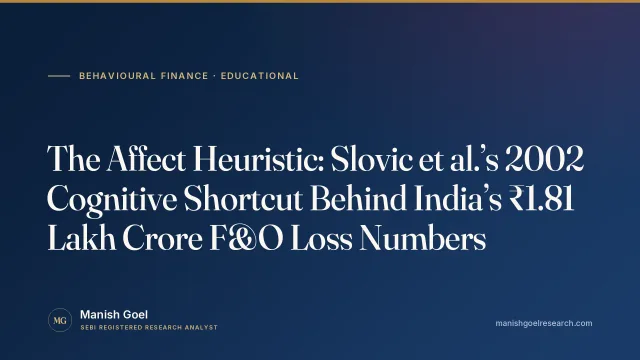
The Affect Heuristic: Slovic et al.’s 2002 Cognitive Shortcut Behind India’s ₹1.81 Lakh Crore F&O Loss Numbers

Pick a stock you “feel good” about. Pick a stock you “feel bad” about. Now ask yourself: did the feeling come before or after you looked…

Sales-to-Gross-Block Ratio: The Asset Productivity Test

The Sales-to-Gross-Block Ratio is an asset-efficiency measure. It tells you how many rupees of revenue a company has produced for every rupee of gross fixed assets…

The Framing Effect: Tversky & Kahneman’s 1981 ‘Asian Disease Problem’

If a fund is described as “90% of investors retain capital” you commit. If the same fund is described as “1 in 10 investors lose capital”…

Export Revenue Mix: The Geographic Diversification Test for Indian Small-Caps

The number of registered investors on the National Stock Exchange has crossed eleven crore in 2026, up from roughly three crore in 2020 — a 3.7x…

CWIP-to-Gross-Block Ratio: The Forward-Looking Capex Pipeline Marker That Reveals Whether Indian Companies Are Building Their Future or Stuck With Stranded Assets

Gross Block is the cumulative original cost of every item of property, plant and equipment a company has ever bought or built — buildings, machinery, vehicles,…

CFO/EBITDA Ratio: The Operating-Cash Quality Test

The Securities and Exchange Board of India’s longitudinal study on the Futures & Options segment confirmed what disciplined long-term investors have suspected for years: roughly 9…

The Illusion of Control: Ellen Langer’s 1975 Cognitive Bias That Powers ₹1.81 Lakh Crore of Indian F&O Losses

In 1975, Harvard psychologist Ellen J. Langer published a paper in the Journal of Personality and Social Psychology with a deceptively simple title: “The Illusion of…

Other Income as a Percentage of PBT: The 30-Second Forensic Earnings-Quality Filter

The Securities and Exchange Board of India’s January 2024 study on individual traders in the equity Futures & Options segment is now the single most-cited statistic…

Economic Goodwill: Warren Buffett’s 1983 Berkshire Letter Appendix on the Real Source of Compounding

Accounting goodwill is the residual figure that lands on a balance sheet when one company pays more than fair book value to acquire another. It is…

The Gambler’s Fallacy and Hot-Hand Fallacy: Tversky, Kahneman & Gilovich on the Misperception of Random Sequences

The gambler’s fallacy is the belief that an independent random event is “due” because it has not happened recently. After ten coin flips landing on heads,…

PEG Ratio: Peter Lynch’s Growth-Adjusted Valuation Framework

And yet, 11 crore investors and rising — most of them new to equities — are walking into Dalal Street with the bluntest, most over-used number…

Walter Schloss’s 16 Factors: How Graham’s Quietest Disciple Beat the Market for 47 Years Without Ever Meeting Management

Most Indian investors who have read a few value-investing books know three names by heart: Benjamin Graham, Warren Buffett and Charlie Munger. A few will throw…

Outside View vs Inside View: Kahneman & Lovallo’s Reference-Class Forecasting Discipline

If you ask an Indian retail investor, “What return will your favourite small-cap stock deliver over the next five years?” you will almost always get a…

Beneish M-Score: The 8-Variable Forensic Model That Caught Enron Three Years Before Bankruptcy

According to the latest SEBI study on individual traders in the equity Futures & Options segment, 9 out of 10 lose money. Combine that with the…

The Twenty-Punch-Card Rule: Warren Buffett’s Lifetime-Scarcity Discipline for Indian Value Investors

In 1991, on stage at the University of Notre Dame, Warren Buffett offered a single thought experiment that, if taken seriously, would have saved Indian retail…

Book Value Per Share (BVPS) Compounding: Warren Buffett’s 53-Year Berkshire Yardstick

Most retail Indian investors stare at the share price 50 times a day and never look at the book value once a year. That single habit…

The Lollapalooza Effect: Charlie Munger’s 1995 Harvard Doctrine on Multiplicative Forces

There is a kind of investment outcome — both spectacular wealth-creation and spectacular wealth-destruction — that no single explanation ever fully accounts for. The 2008 Lehman…

Action Bias: Bar-Eli et al.’s 2007 Goalkeeper Study and Why Indian Investors’ Compulsion to ‘Do Something’ Destroys Long-Term Returns

Action bias is the systematic, cross-cultural human tendency to favour action over inaction even when inaction is the statistically superior choice. The bias kicks in hardest…

EBITDA Margin: The Profitability Yardstick Every Indian Value Investor Must Master

EBITDA Margin tells you, in a single number, what fraction of every rupee of revenue a business converts into earnings before paying interest, taxes, depreciation, and…

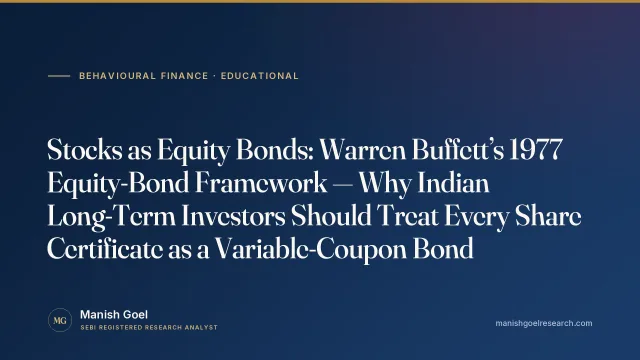
Stocks as Equity Bonds: Warren Buffett’s 1977 Equity-Bond Framework — Why Indian Long-Term Investors Should Treat Every Share Certificate as a Variable-Coupon Bond

One of the most useful sentences ever written about equity investing is buried in a 1977 Fortune essay titled “How Inflation Swindles the Equity Investor”. Warren…

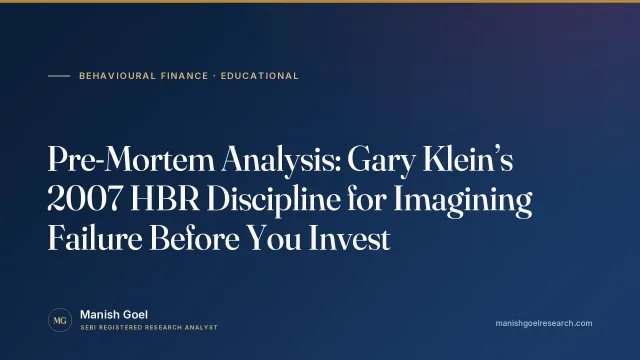
Pre-Mortem Analysis: Gary Klein’s 2007 HBR Discipline for Imagining Failure Before You Invest

If you can imagine, in vivid and unflattering detail, the precise way an investment will fail before you ever click “Buy” — and write that obituary…

Return on Capital Employed (RoCE): The Single Most Important Profitability Metric for Indian Value Investors

Warren Buffett has called it “the single most important number in business analysis.” Charlie Munger built much of Berkshire’s bolt-on acquisition discipline around it. Indian equity…

The securities quoted in these articles are for illustration only and are not recommendatory. Investment in securities market are subject to market risks. Read all the related documents carefully before investing.