The Shopkeeper’s Cut
The trade margin is the slice of the printed price that never comes back to the company. What it reveals about brand strength — and the four things it cannot tell you.
SEBI Registered Research Analyst · INH100004775
Independent equity research by Manish Goel, Chartered Accountant. Each year I study a small number of Indian listed companies the slow way — annual reports, cash flows, governance, valuation — and publish detailed research on the four that best meet my standards.
Four research reports · All four on day one · No trading calls · No assured returns

One plan, kept simple
There are no tiers, no trading calls and no add-ons. Four in-depth research reports — one company each — written for investors who intend to own for the long term. You pay once, and all four reach you on the same day.
If my view on any of the four companies changes materially within twelve months — for example, a downgrade or an exit — you also receive a short note saying what changed, at no charge.
Research plan
₹1,77,000for four research reports
₹1,50,000 + 18% GST · paid once
Fees are paid only through banking channels to Manish Goel — never in cash. Once the reports are delivered the fee is not refundable; if they cannot be delivered, it is refunded in full. One plan per family in any 12 months, within SEBI’s limit of ₹1,51,000 per family per year (excluding GST).
Inside every report
Written in plain English, with the reasoning shown — so you can judge it for yourself rather than take it on trust.
What the company sells, who pays for it, and why customers keep coming back.
Competitive position, pricing power, industry structure — and what could erode them.
Promoter record, capital allocation, related-party dealings, pledges and auditor remarks.
Growth, margins, return on capital, debt — and how much of the profit turns into cash.
The valuation at the time of the recommendation, how it compares with peers and history, and the assumptions behind the five-year view.
The specific developments that would prove the thesis wrong, and the triggers for a review or exit.
Each report also carries the disclosures required under the SEBI (Research Analysts) Regulations, 2014 — including any holding or financial interest in the company.
The process
The listed universe is narrowed to businesses with long records of profit, sensible debt and real cash generation.
Ten years of annual reports, notes to accounts, auditor reports, shareholding patterns and filings — read in full.
The story is tested against the real world: products, customers, competitors, and what management said versus what it did.
What the business may be worth on conservative assumptions — with a margin of safety for the mistakes every analyst makes.
The full reasoning, including the risks. Each company is then reviewed after its results, and clients are told if my view changes materially.
What the research stands on
Four recommendations a year leaves time to know each business properly — and to keep following it.
The question is never where the price goes next month, but what the business can earn over the next five years.
Reported profit can be an opinion; cash in the bank is a fact. The research follows the cash.
A good business run by people who do not treat minority shareholders fairly is not a good investment.
Even an excellent company can be a poor investment if bought at the wrong price.
Fit
Research is the same for every subscriber and does not take your personal circumstances into account. If you need personalised advice, consult a SEBI-registered investment adviser.
Start here
Eighteen lessons on business quality, valuation and investor behaviour, most with a short explainer video. They are not research reports and not recommendations.
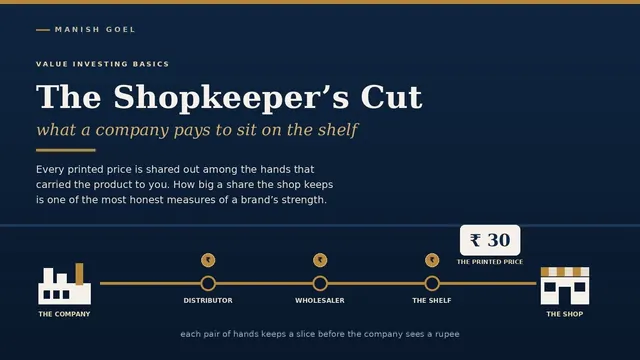
The trade margin is the slice of the printed price that never comes back to the company. What it reveals about brand strength — and the four things it cannot tell you.
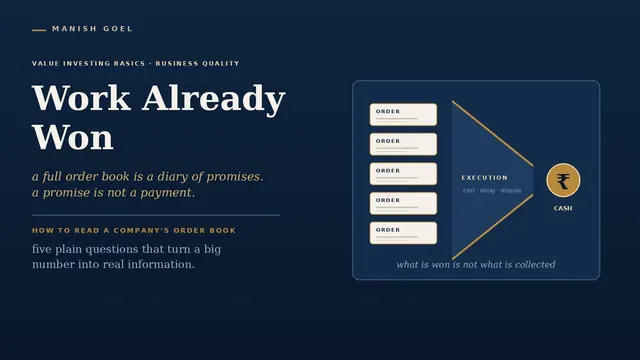
An order book is a diary of promises, not a bank balance. Five plain questions that turn a big headline number into real information.
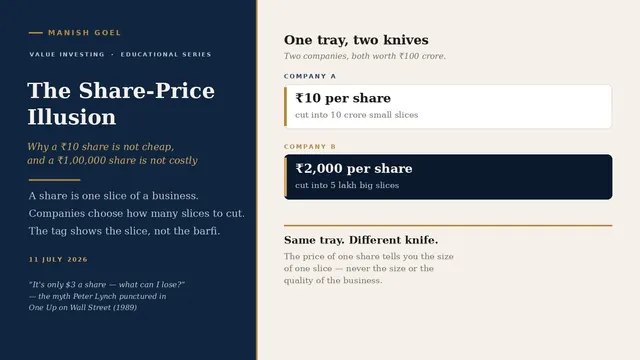
Why a ₹10 share is not cheap and a ₹1,00,000 share is not costly — and what to look at instead of the price tag.
Blog
A new plain-English lesson most mornings — on judging businesses, reading annual reports and investor behaviour. Educational only, never a recommendation.
A sweet shop and a flat builder can stand on the same street and feel the same news very differently. Here is a simple test for…

Some businesses reach their customers through their own front door. Others reach them through a door that belongs to someone else. Here is how to tell…

Some businesses decide their own price. Others are simply told the price every morning. Here is how to tell the two apart, and why the second…
Featured in
Some were brand or sponsored features. See the awards and read the articles
Begin
Write to me with your name and city. I will explain how the research works, complete your KYC, share the terms for your consent — and only then send the fee details.
WhatsApp: +91 73801 22211 — please save the number first, then send a message.