Value investing · Educational
The EMI Test: Why a Business Whose Customers Buy on Loan Rises and Falls With the Cost of Borrowing
A sweet shop and a flat builder can stand on the same street and feel the same news very differently. Here is a simple test for spotting which businesses depend on cheap loans for their customers, and why it matters.
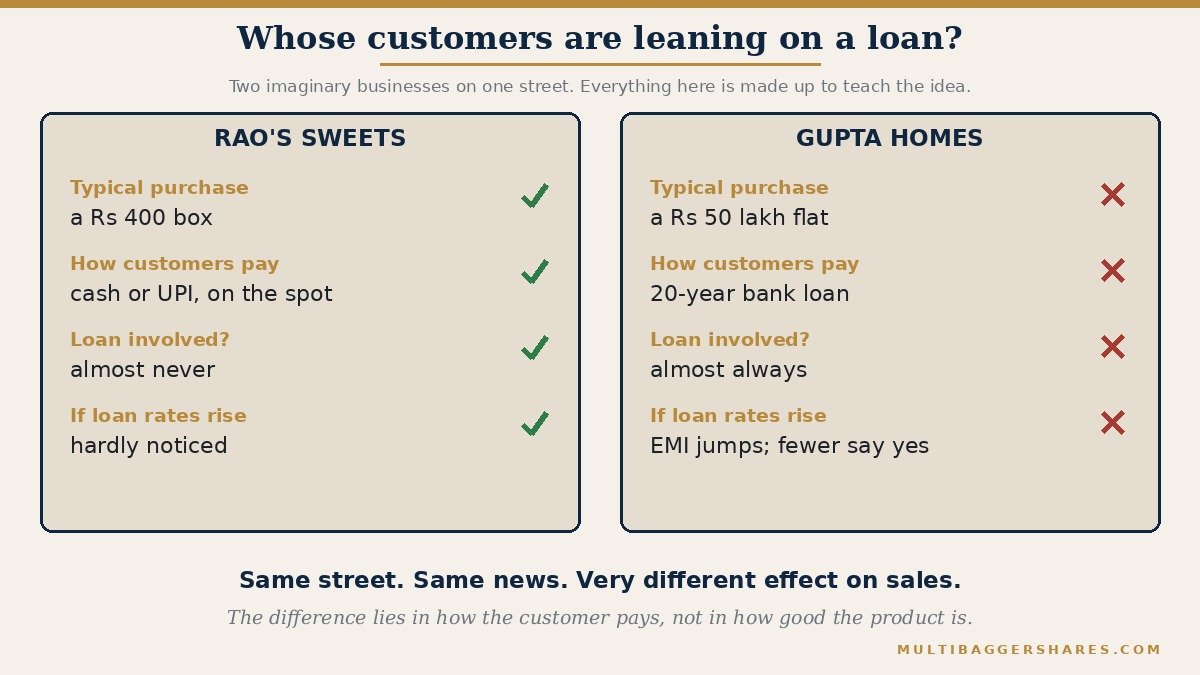
Two shops stand side by side on a busy street in Nagpur. Everything in this story is made up to teach an idea. The first is Rao’s Sweets, where a box of kaju katli costs Rs 400 and nearly everyone pays in cash. The second is the sales office of Gupta Homes, a small builder that sells flats for Rs 50 lakh each, and almost every buyer takes a bank loan to pay for one.
One year, the banks raise the rates they charge on home loans by two percentage points. Rao notices nothing. His Diwali boxes sell out as usual. At Gupta Homes, the phones go quiet. Visitors still come, still admire the model flat, and still say they love the balcony. But fewer of them come back with their loan papers. Both shops have good products and honest owners. Only one of them has customers who are leaning on a bank.
Today’s lesson is about that difference. It is about how to notice which businesses depend on their customers’ loans, and why that single fact can make a business’s sales rise and fall like a swing, even when the business itself has done nothing wrong.
What it really means
Most of us do not buy a flat, a car, or even a refrigerator by paying the full price on the day. We pay a little every month. That fixed monthly payment is called an EMI (short for equated monthly instalment, the same amount you pay the bank on the same date each month until the loan is cleared). Each EMI has two parts. One part pays back the money you borrowed. The other part is interest (the fee the bank charges for lending you the money).
The size of your EMI depends on three things: how much you borrowed, how many years you take to repay, and the interest rate (the yearly price of borrowing, shown as a percentage of the loan). Change any one of the three and the EMI changes. The buyer in a showroom rarely asks, “What is the price?” The buyer usually asks, “What will my instalment be?” That second question is the one that decides the sale.
Now think of a family’s monthly budget as a thali (a steel plate with room for only so much food). Rent, school fees, groceries, and the EMI all have to fit on the plate. If the interest rate rises, the same flat now needs a larger EMI. The plate has not grown, so something has to give. The family may borrow less, choose a smaller flat, wait for a better time, or give up on the idea. Multiply that by thousands of families, and the builder feels it in his sales.
In India, rates on many floating-rate home loans (loans whose rate can move up or down over time) are linked to the repo rate (the rate at which the Reserve Bank of India, the country’s central bank, lends to banks). So when the RBI changes its rate, many borrowers see a change in their own loan rate soon after. That is why a decision taken in a meeting room in Mumbai can be felt in a sales office in Nagpur.
Why it works
Three ideas help here. The first is that the bigger the purchase, the more the loan matters. Rao’s Rs 400 box is paid from the wallet. Nobody takes a twenty-year loan for kaju katli. For small, everyday purchases, the interest rate hardly matters at all. For a large purchase, the loan is not a side detail. It is the way the purchase happens.
The second idea is that the longer the loan, the harder a rate change bites. Let us use made-up rates to see it. Take a Rs 50 lakh home loan for 20 years. At an interest rate of 8%, the EMI comes to about Rs 41,822. At 10%, the same loan needs about Rs 48,251 every month. That is Rs 6,429 more, or about 15% higher, for exactly the same flat. Over the full twenty years, the interest alone grows from about Rs 50 lakh to about Rs 66 lakh. (These rates are chosen only for the example. They are not today’s rates, and they are not a prediction.)
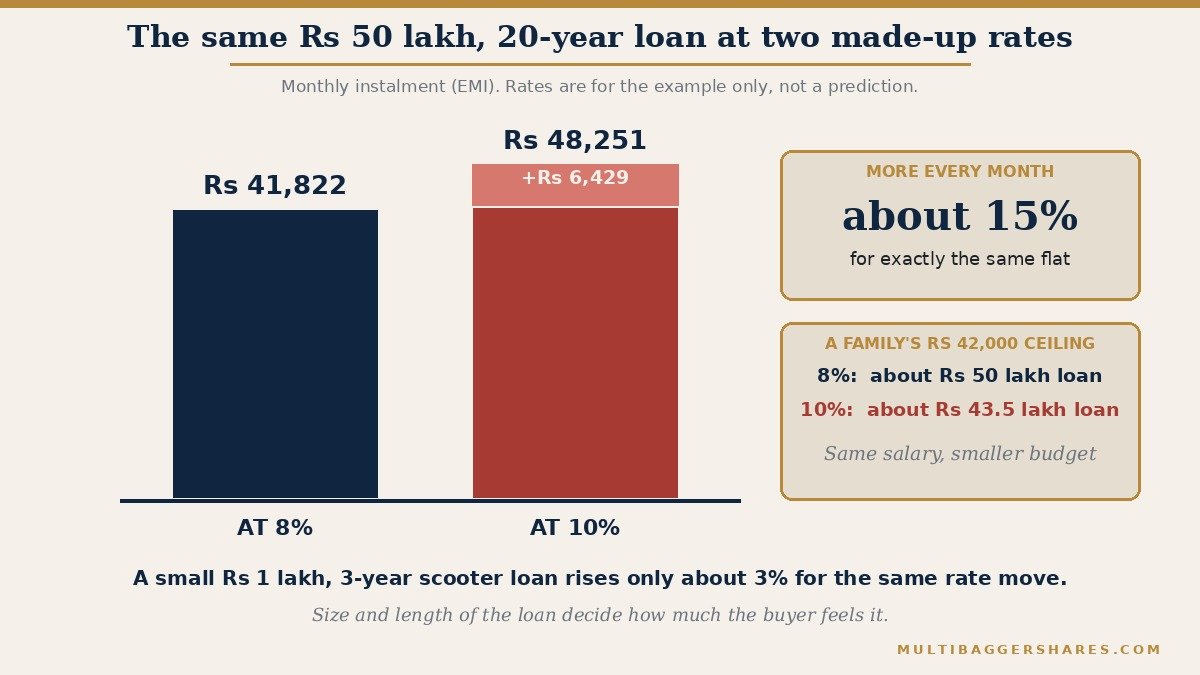
Now compare a small loan. A scooter costing Rs 1 lakh, repaid over three years, has an EMI of about Rs 3,227 at 10% and about Rs 3,321 at 12%. That is a rise of Rs 95 a month, or about 3%, even though the rate moved by the same two points. The rate change is the same. The pain is not. Size and length of the loan decide how much the buyer feels.
The third idea is the budget ceiling. Suppose a family can safely give Rs 42,000 a month to a home loan. At 8%, that is enough to borrow about Rs 50 lakh. At 10%, the same Rs 42,000 will carry only about Rs 43.5 lakh. Their salary has not changed at all, yet the family’s shopping budget has quietly shrunk by about Rs 6.5 lakh, or roughly 13%. Some of these families will buy a smaller flat. Some will rent for another year. A few will simply drop out. Each of those choices reduces the builder’s sales, and the builder did not change anything.
Notice also what happens in the opposite direction. When loan rates fall, the same family can borrow more, EMIs shrink, and more customers can say yes. Sales in such businesses can rise faster than the real needs of customers. Looked at together, the two directions explain why the sales of loan-driven businesses tend to swing more than the sales of cash businesses. The swing comes from the cost of borrowing, not from the quality of the product.
A real example or two
Our first example is a piece of Indian history, told only as a record. On 4 May 2022, in a surprise announcement between its scheduled meetings, the RBI raised its repo rate by 40 basis points (a basis point is one hundredth of a percentage point, so 40 basis points is 0.40 of a percentage point) to 4.40%. More increases followed over the next nine months. On 8 February 2023, the RBI raised the rate by a further 25 basis points to 6.50%. Taken together, the repo rate had gone from 4.00% to 6.50% in under a year, which is a rise of 2.5 percentage points. The RBI’s own statement in February 2023 spoke of the rate increases since May 2022 working their way through the system. That phrase is worth remembering. It tells us that a rate change does not land all at once. It travels, loan by loan, until it reaches the customer’s monthly instalment.
Our second example comes from another country, and it shows the same pattern at a larger scale. In the United States, mortgage rates (the rates on home loans) rose sharply during 2022 and 2023. According to the National Association of Realtors, existing homes sold in the US during 2023 totalled about 4.09 million, an 18.7% fall from 2022. That was the lowest yearly figure in nearly thirty years, and the association linked it to the sharply higher mortgage rates. Many families did not stop wanting homes. Many simply could not make the monthly instalment fit on the thali.
Read these two stories side by side. In both, the product was the same and the owners were the same. What changed was the price of the loan that stood between the customer and the purchase. Neither story says anything about any particular company, and nothing here is a view on any share. They simply show how far a change in the cost of borrowing can travel.
Now picture the opposite kind of business. A neighbourhood medical shop sells strips of tablets, mostly for cash, mostly in small amounts, month after month. When loan rates move, the medical shop hardly shifts. That does not make it a better business than a builder or a car dealer. It only makes it a different kind of business, with a different kind of risk. A careful investor wants to know which kind he is looking at.
How you can use it
You do not need to guess where interest rates will go. Even skilled investors say that cannot be done reliably. Howard Marks, the co-founder of Oaktree Capital, once gave a memo to his clients the title “You Can’t Predict. You Can Prepare.” That is the spirit here. We are not trying to forecast rates. We are trying to notice which businesses would feel a change, so that nothing comes as a surprise. You need only an annual report (the yearly document in which a company describes its business and its numbers) and five plain questions. Call them the EMI test.
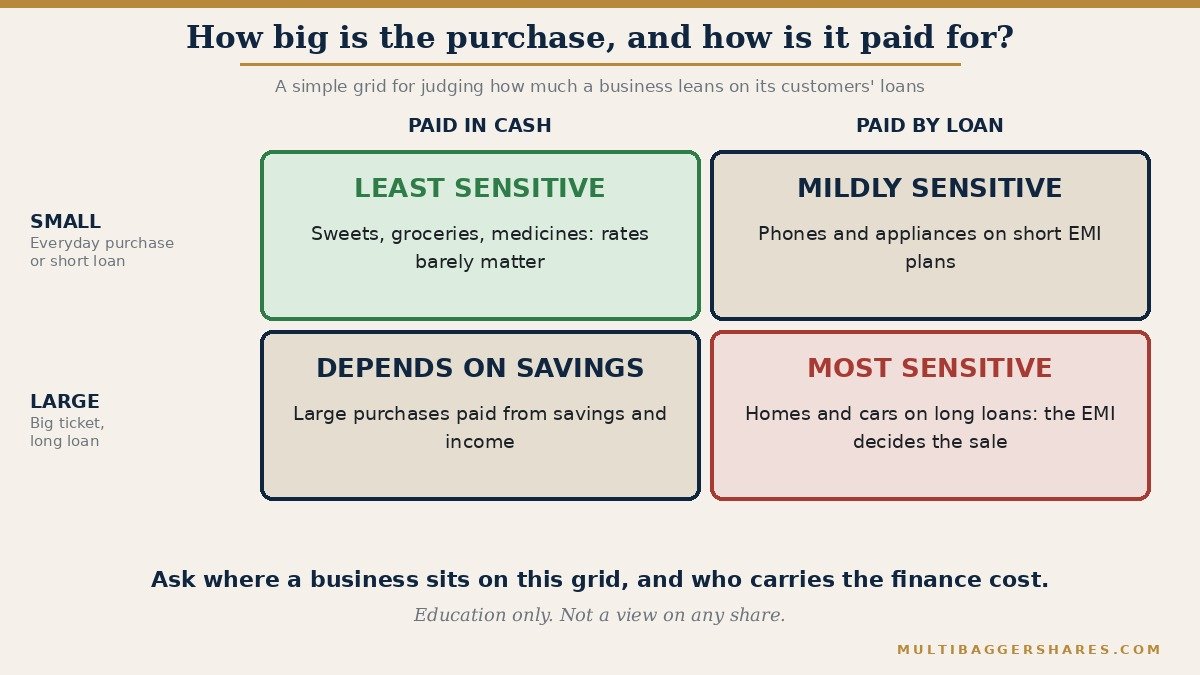
Question one: how do most customers pay, in cash or by loan? The annual report often has a section called management discussion (the part where the company’s managers explain the year in their own words). Look for mentions of loan availability, interest rates, or finance schemes. A business that keeps saying “our customers need easy finance” is telling you something.
Question two: how big is the purchase compared with a month’s income, and how long is the loan? A flat or a car is a large purchase on a long loan. A phone or a mixer-grinder on a six-month EMI plan is small and short. The larger and longer the loan, the more the business leans on the cost of borrowing.
Question three: does the company itself help pay for the customer’s loan? Many sellers offer “zero-cost EMI” or other finance deals. Someone pays for that. Often the seller does, through discounts or fees, which can quietly eat into its own profit. If the company is carrying part of the interest cost, a change in rates can hit it twice: once through fewer customers and once through a higher bill.
Question four: what happened to its sales the last time rates went up? This is the most useful question, because it uses the company’s own history instead of your opinion. Open the annual reports for the years around 2022 and 2023. Compare sales in the years before and after rates rose. Did sales slow sharply, or hold steady? Did the company cut prices to keep customers? Remember to look at more than one year, because families sometimes rush to buy just before a rate change and pause just after.
Question five: how strong is the company’s own balance sheet (the statement that lists what a company owns and what it owes)? A business that sells on customers’ loans will sometimes have a quiet year. If it has little debt of its own and some cash in hand, it can wait out the slow patch calmly. If it is itself borrowing heavily, a slow year in sales and a high cost of its own borrowing can arrive together. That is a hard combination, and it is worth separating from the question of customer loans.
A few cautions will keep you balanced. First, rates are only one of many things that move a customer’s decision. Jobs, incomes, prices, and festival seasons all matter too. Second, a rate-sensitive business is not a bad business. Many fine businesses sell homes, cars, and appliances. The point is to know the nature of the swing, so that a slow year does not shake you into a hasty decision. Third, the lesson works in both directions. A year of easy loans can make a business look stronger than it is, because customers are borrowing their way into buying. The honest question is always how much of today’s sales rests on cheap borrowing.
There is something calming in all this. We cannot control the RBI, and we cannot know the next rate decision. But we can control what we understand. An investor who knows that a builder’s sales swing with loan costs will not be frightened by a slow quarter, and will not be carried away by a very fast one.
Return one last time to Rao and Gupta. A few seasons later, Gupta started something sensible. He kept more cash in the bank, avoided heavy borrowing for new land, and planned his launches knowing that some years would be slow. Rao went on selling kaju katli. Neither shop was wiser than the other. Each simply understood how its own customers paid, and planned for it. That is the whole lesson of the EMI test.
This article is for education only. It does not tell you what to do with any particular investment.
Key takeaways
- An EMI is the fixed monthly payment on a loan; for big purchases, customers decide on the instalment, not on the price, so the interest rate shapes the sale.
- The larger and longer the loan, the harder a rate change bites: in the made-up example, a rise from 8% to 10% lifts the EMI on a Rs 50 lakh, 20-year loan by about 15%, but a Rs 1 lakh, 3-year scooter loan by only about 3%.
- A family with a fixed monthly ceiling borrows less when rates rise, so sales of loan-driven businesses can swing without any change in the product.
- History shows the pattern: the RBI’s repo rate moved from 4.00% to 6.50% between May 2022 and February 2023, and US existing-home sales in 2023 fell 18.7% to about 4.09 million as mortgage rates rose.
- Use the EMI test: how customers pay, how big and long the loan is, who carries the finance cost, what happened to sales last time rates rose, and how strong the company’s own balance sheet is.
Educational content. This article is for education only. It is not a research report and not a recommendation to buy, sell or hold any security, and it does not take your personal circumstances into account. The securities quoted are for illustration only and are not recommendatory.
Investment in securities market are subject to market risks. Read all the related documents carefully before investing.
Registration granted by SEBI, enlistment as RA with Exchange and certification from NISM in no way guarantee performance of the intermediary or provide any assurance of returns to investors.

Manish GoelChartered Accountant and SEBI Registered Research Analyst (INH100004775). Writes about business quality, valuation and investor behaviour. About