The Shopkeeper’s Cut
The trade margin is the slice of the printed price that never comes back to the company. What it reveals about brand strength — and the four things it cannot tell you.
Blog
Plain-English lessons on judging businesses, reading annual reports and staying patient — 370 articles and counting, a new one most mornings. Educational only: none of these is a research report or a recommendation.
Start here
The essentials first: how to judge a business, what a share price can and cannot tell you, and how to stay patient. Most come with a short explainer video.
How to tell a durable business from a busy one.
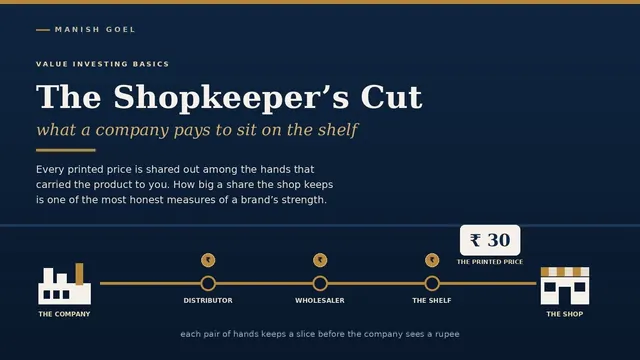
The trade margin is the slice of the printed price that never comes back to the company. What it reveals about brand strength — and the four things it cannot tell you.
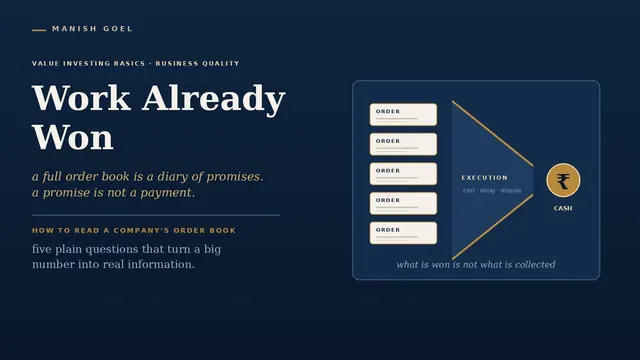
An order book is a diary of promises, not a bank balance. Five plain questions that turn a big headline number into real information.

Some companies collect a small fee from a huge crowd, year after year. The four marks of a genuine toll booth — and the traps that imitate one.
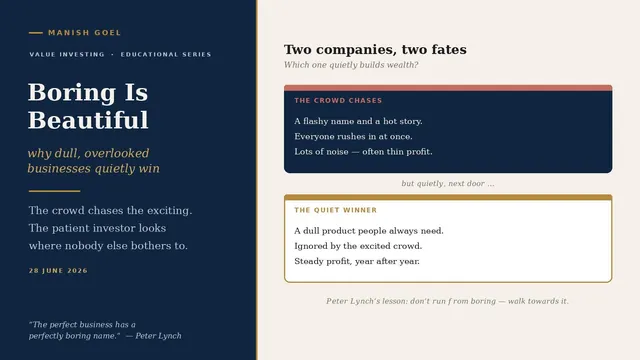
Dull, overlooked businesses with steady profits can quietly reward patient owners. Why boring helps — but only when the business is strong.
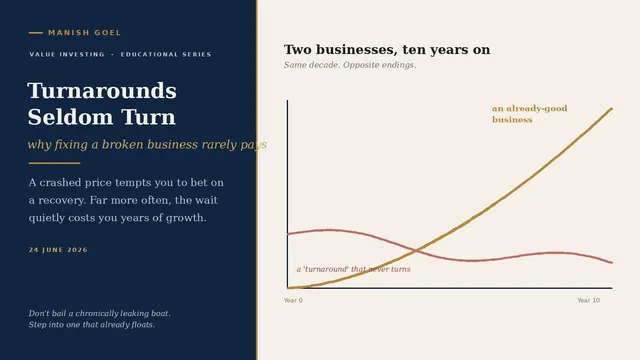
A crashed price tempts you to bet on a recovery. Why broken businesses rarely heal, and the signs of one that is already working.
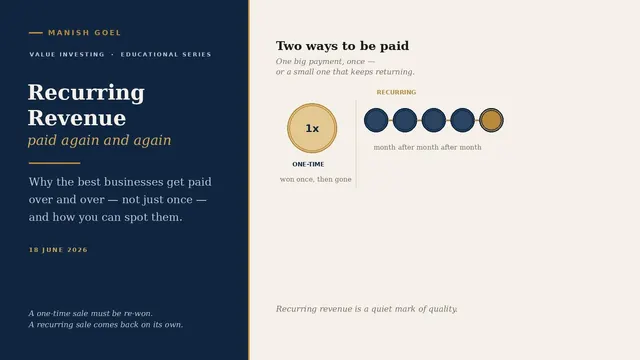
A business that gets paid again and again is calmer and sturdier. How to spot recurring revenue in a company’s numbers.
What a share price can and cannot tell you.
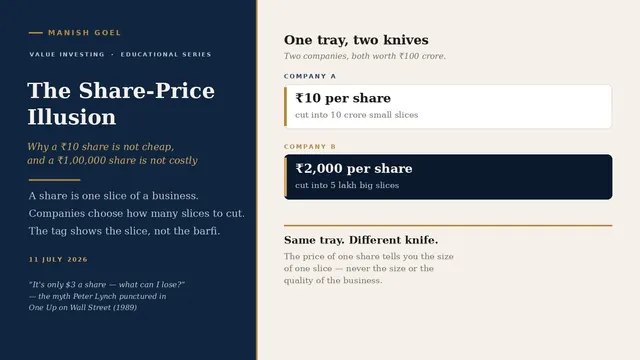
Why a ₹10 share is not cheap and a ₹1,00,000 share is not costly — and what to look at instead of the price tag.
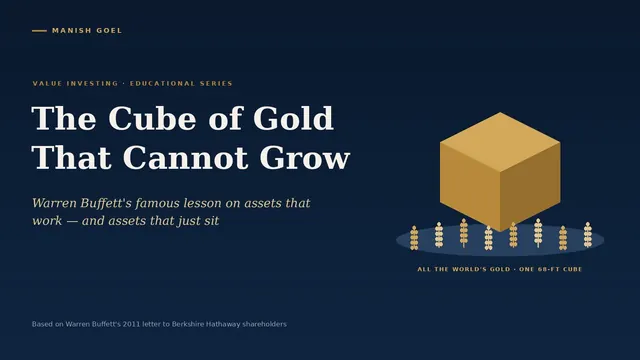
All the gold ever mined would fit in one cube that will never grow. Buffett’s lesson on assets that work and assets that just sit.
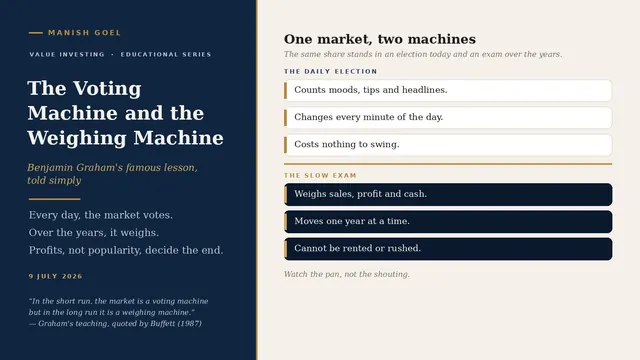
In the short run the market counts votes; in the long run it weighs profits. Graham’s lesson on why popularity fades and earnings win.
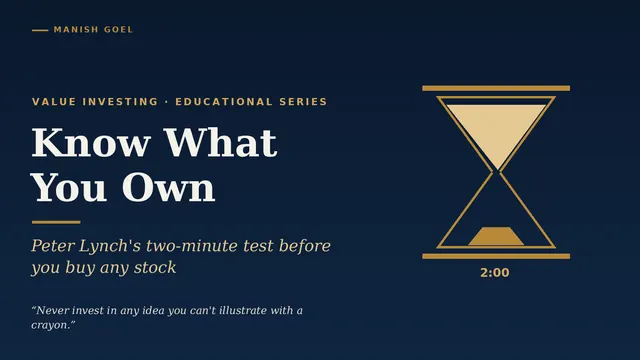
Peter Lynch’s two-minute test: if you cannot explain why you own a business in plain words, you are holding a price, not a company.
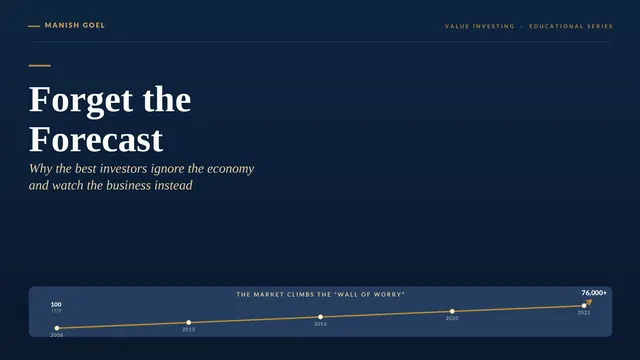
Interest rates, elections and the next market move are almost impossible to predict. What you can study instead: the business.

The same screen can host two different games. Graham’s test for telling an investment from a bet — and why the difference matters so much.
Staying solvent, patient and calm when markets are not.
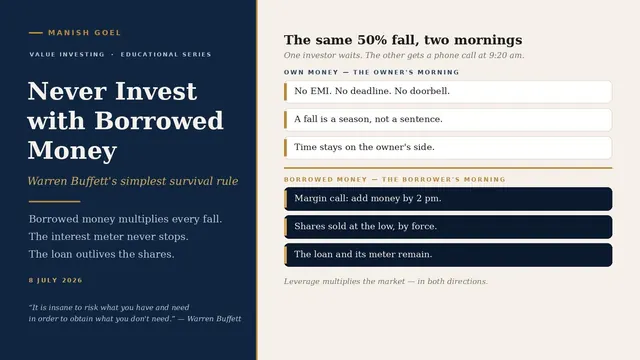
Leverage creates nothing of its own — it only multiplies. Why borrowed money can turn an ordinary fall into a permanent loss.

A market price is an offer, not an order. Graham’s safety-cushion rule, and three arrangements that keep a crash from forcing your hand.
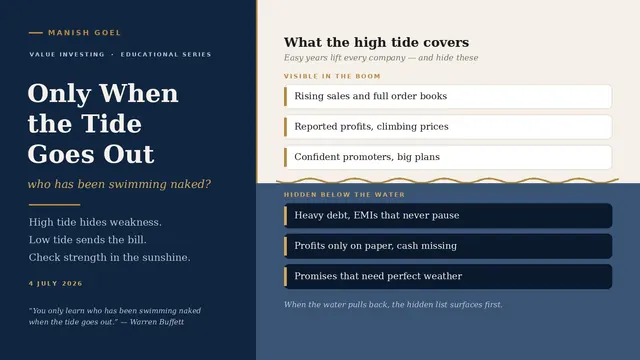
Easy money hides weak companies. Five signs of a business that can survive a bad year — to check before the tide turns.

Markets test behaviour more than intelligence. Why the calm investor tends to outlast the clever, anxious one — and how to build calm.
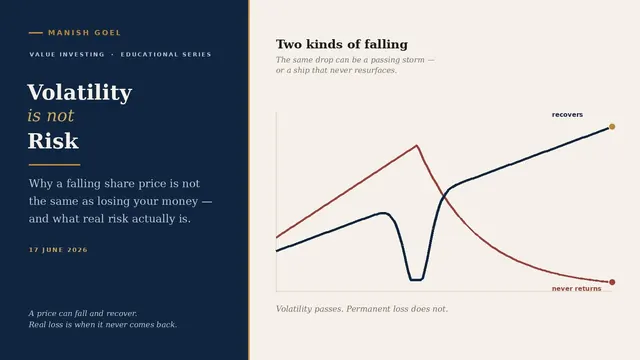
A falling price is not the same as losing money. The difference between a temporary dip and a permanent loss — and how to avoid the second.
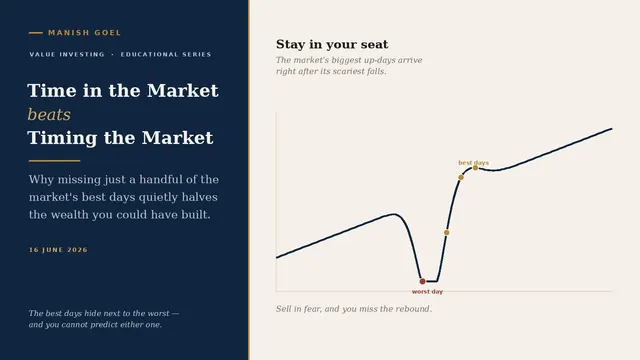
The market’s best days sit right next to its worst. Why staying invested usually matters more than picking the moment.

A sweet shop and a flat builder can stand on the same street and feel the same news very differently. Here is a simple test for…

Some businesses reach their customers through their own front door. Others reach them through a door that belongs to someone else. Here is how to tell…

Some businesses decide their own price. Others are simply told the price every morning. Here is how to tell the two apart, and why the second…

Some businesses are really one remarkable person with a shop around them. Here is why that is a hidden weakness, how great businesses plan for the…
Philip Fisher warned in 1958 against falling for the tone of a company’s annual report. Here is what that means, why glossy words prove nothing, and…

When a whole field starts to grow, every business in it seems to ride the same wave. Basant Maheshwari says it does not work that way.…
Every old shop in your town has already passed a test that no analyst can run for it. Here is how to read the age of…

Some businesses spend big every single year and end up exactly where they began. Others spend a little and keep what they earn. Learning to tell…

Your broker's statement records every mistake that lost you money. It records nothing about the great opportunities you sold too early or never studied. Indian value…

In a famous Sherlock Holmes story, the clue that solved the case was something that did not happen. The same habit, noticing what is missing, can…

In 1935 the best pilots in America crashed a brand-new bomber because of one forgotten step. The fix was not more training. It was a short…

A bank is a shop that sells money, and the price it pays for the money it buys matters as much as the price it charges.…

Suppliers, workers, lenders and the tax collector all take their share of a business's money before the owner sees a paisa. Seeing that queue shows why…
When a company's profit falls, the first explanation is rarely the real one. A habit from a Japanese car factory shows how to keep asking why…

Water keeps us alive, yet it sells for almost nothing. A diamond keeps nobody alive, yet it sells for a fortune. Here is what that old…

When money runs short, a family stops buying some things at once and other things never. A business that sells the second kind has steadier sales.…

A grandmother sifts flour through a sieve so that only the fine part passes. Chandrakant Sampat did the same with the stock market, using three plain…

Every business is a chain of steps, and the whole chain can only run as fast as its slowest one. Knowing where that step is, and…

Any business looks wonderful in a bumper year. The more useful question is what its owners do with the extra money: strengthen the business, or stretch…

Two pickle makers can report the same sales and the same profit, and still be very different businesses. The difference is who is standing at the…

Two milk rounds, the same milk, the same price, the same forty customers. One earns a living and the other loses money. The difference is route…

A simple question separates a strong business from one that only looks strong: if a rich rival tried to copy it tomorrow, what could the money…
Every business pays something to win a new customer. The quiet question is how long that customer stays and what they bring while they are there.…

Every household keeps an umbrella for the day it rains. A business keeps spare cash for the same reason. But the best businesses use that cash…
The securities quoted in these articles are for illustration only and are not recommendatory. Investment in securities market are subject to market risks. Read all the related documents carefully before investing.