Behavioural finance · Educational
The Illusion of Control: Ellen Langer’s 1975 Cognitive Bias That Powers ₹1.81 Lakh Crore of Indian F&O Losses
1. The Illusion of Control: What It Is and Why It Quietly Drains Wealth
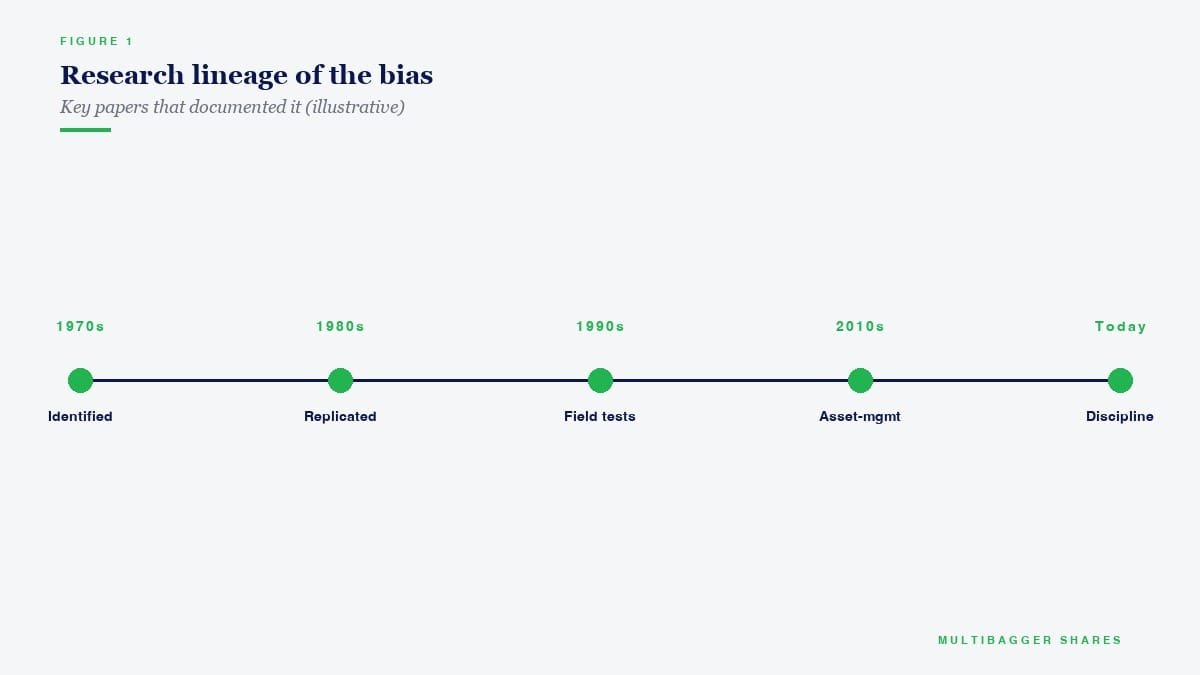
In 1975, Harvard psychologist Ellen J. Langer published a paper in the Journal of Personality and Social Psychology with a deceptively simple title: “The Illusion of Control.” Across six experiments, Langer demonstrated that people behave as though their personal involvement — their choice of lottery ticket, their physical posture, the speed of their throw — could influence outcomes that were, by design, entirely random. Subjects who had picked their own lottery ticket demanded an average of $8.67 to sell it back; subjects assigned a ticket asked for only $1.96. The ticket was identical. The probability of winning was identical. The only thing that changed was the subject’s belief that “because I chose it, I have some control.”
Half a century later, this single cognitive distortion — the belief that we can influence outcomes that are mostly or entirely a function of randomness — is responsible for more wealth destruction in Indian retail portfolios than any other behavioural error. It is the engine that powers intraday trading, technical-analysis subscriptions, options writing during expiry weeks, and the certainty in WhatsApp groups that “I will exit before the correction.” The illusion of control does not feel like a bias. It feels like skill.
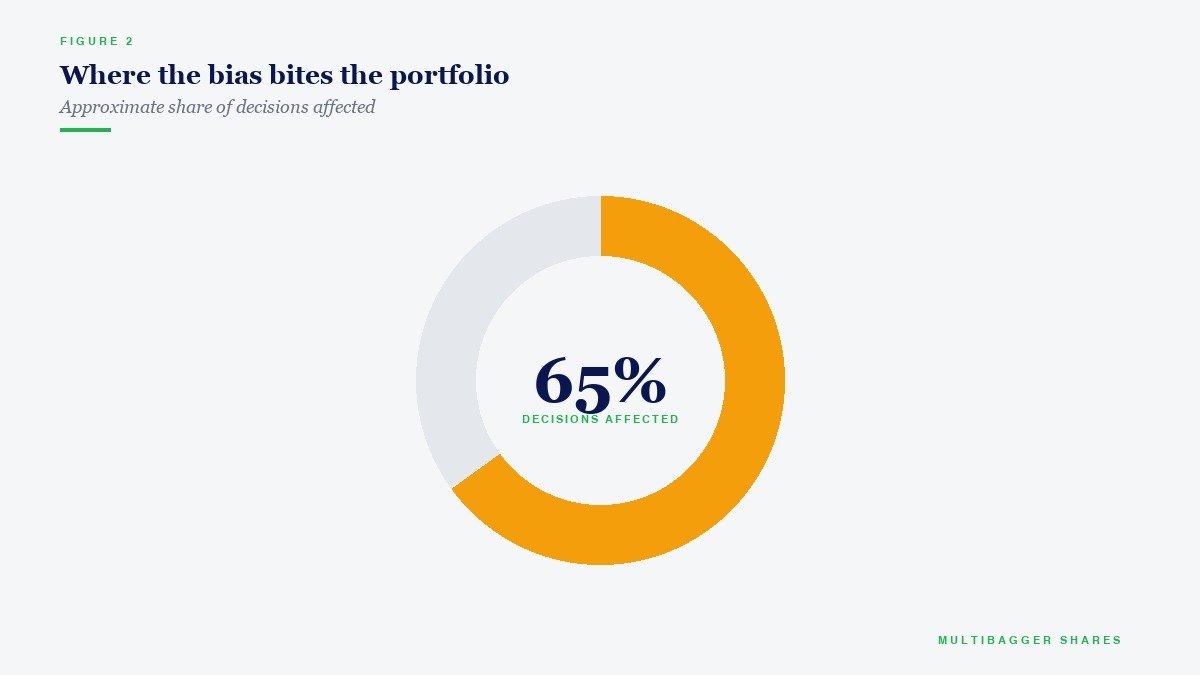
The cost is not theoretical. SEBI’s January 2023 study on individual trader profitability in the equity F&O segment found that 89% of individual traders incurred net losses in FY22, with average losses of ₹1.10 lakh per loss-maker. SEBI’s September 2024 follow-up extended the window to FY22–FY24 and found that 91.1% of individual F&O traders across three years lost money, with aggregate net losses of ₹1.81 lakh crore. The losers, on average, made roughly 120 trades per year. The winners made fewer. The single best predictor of being in the losing 9 out of 10 was not lack of intelligence — it was the frequency of action driven by an illusion that the next trade was the one you could control.
2. The Underlying Psychology: Why the Brain Manufactures Control Where None Exists
Langer identified four conditions under which the illusion of control becomes most acute. Each one maps disturbingly well onto the modern Indian retail-investing experience.
(a) Choice. The mere act of choosing — even when the choices are equivalent — increases the perceived control over the outcome. A retail investor who has scrolled through a screener, applied filters, and picked a stock feels more in control than one who bought a Nifty 50 index fund, even when the screener-picked stock has identical or worse expected returns net of cost.
(b) Familiarity with the stimulus. The more familiar the task looks, the more controllable it feels. Candlestick charts, RSI, MACD, Bollinger bands — these familiar visual patterns trigger the brain’s pattern-completion machinery and create the sensation that the next move is foreseeable, even when academic evidence shows the patterns have negligible out-of-sample predictive value.
(c) Active involvement. The more actions you take, the more you feel you are influencing the result. This is why the SIP investor who does nothing for ten years often outperforms the active trader who watches the screen all day. Both face the same market. One feels in control; one actually is in control of the only thing that matters — the holding period and the cost of trading.
(d) Competition. When outcomes are framed as a contest with another trader, the illusion intensifies. Telegram leaderboards, broker apps that display your “rank”, and finfluencer-led “trader battles” all weaponise this fourth Langerian condition.
Subsequent research deepened the finding. Fenton-O’Creevy, Nicholson, Soane & Willman (2003) studied 107 professional London traders across four City investment banks and found that traders with higher illusion-of-control scores produced lower earnings, lower analyst rankings, and lower risk-management ratings. The effect was not small — it was on the order of one rank decile per standard deviation of bias. The illusion of control, in their data, was not a quirk of amateurs. It was a measurable handicap even among trained professionals.
3. The Indian Manifestation: Demat Accounts, Discount Brokers, and the F&O Casino
India is currently running the largest natural experiment in the illusion of control in financial history. As of March 2024 (NSE retail participation report), India had crossed 15.14 crore demat accounts, up from 4.09 crore in March 2020 — a near-fourfold increase in four years. The same period saw the rise of zero-brokerage discount platforms, mobile-first onboarding, and a generation of finfluencers selling the dream that with the right setup, one could “control” market outcomes.
What happened next is in the data:
SEBI’s 27 September 2024 study on the equity derivatives segment, covering FY22–FY24, found that 91.1% of 1.13 crore individual traders lost money in F&O. The aggregate net loss was ₹1.81 lakh crore. The top 1% of profit-making traders accounted for the bulk of all gains, and a significant share of those came from proprietary desks and algorithmic accounts — not retail individuals. Even after deducting transaction costs, only 1% of individual traders earned more than ₹1 lakh in net profit. The median F&O trader was a sub-30, salaried, urban Indian who had crossed into derivatives within 12 months of opening a demat account — the textbook profile of a Langerian subject who had been given choice, familiarity, active involvement, and competition.
NSE’s India Equity Markets — Pulse Report (March 2024 issue) showed that retail investors accounted for 35.9% of average daily turnover in the cash market, but the average holding period had collapsed to under three months for 47% of new demat holders. Three months is not investing. Three months is the timescale on which the illusion of control is most active and most expensive.
Indian academic work has extended these findings. Prof. V. Ravi Anshuman (IIM Bangalore) and co-authors, in “Retail Trading and Returns: Evidence from the Indian Stock Market” (2021, working paper series), documented that retail-heavy stocks on the NSE underperformed institutionally-held stocks by approximately 3.4% per annum over a five-year window after controlling for size, value, and momentum. Their preferred explanation: retail flow is dominated by overconfident, control-seeking trading rather than information-driven rebalancing.
4. The Counter-Measure Checklist: Eight Disciplines That Defuse the Illusion
The illusion of control cannot be argued away. It must be designed away. Here is an eight-point operating checklist that the serious Indian long-term investor can install today:
(i) Pre-commit to a fixed action frequency. Decide in advance how many portfolio actions you will take per year. Buffett famously said his ideal is “one or two great ideas a year.” For most retail investors, a cap of 6–10 portfolio actions per year forces a Langerian subject to slow down.
(ii) Separate the decision from the outcome in your journal. For every buy/sell, write down (a) the thesis, (b) the disconfirming evidence, (c) the time horizon, and (d) the random-noise band you expect within that horizon. Reviewing the journal annually breaks the mental link between the action and the outcome — the very link the illusion feeds on.
(iii) Pay yourself a “do-nothing” fee. Track the trades you did not make and what they would have cost or earned over six months. Most investors are stunned by how often the trade they avoided would have been a loss after costs and taxes.
(iv) Use Outside View base rates. Before any action, ask: of the last 100 investors who did exactly this, how did they do? The SEBI 9-out-of-10 number is the base rate for active F&O trading. No amount of personal “skill” feeling can override a 91.1% loss rate.
(v) Eliminate price-watching loops. Daily quotes are the feeding ground of the illusion. Move to weekly or monthly check-ins. Vanguard’s research on US retail accounts showed that the most-frequent-checking decile underperformed the least-frequent-checking decile by 1.5%–2.0% per year on otherwise identical portfolios.
(vi) Ban yourself from the F&O segment unless you can pass a written test. If you cannot articulate, on paper, the gamma exposure of a short straddle the day before expiry, you are buying a lottery ticket and feeling skilled because you “chose” the strikes.
(vii) Replace technical analysis with thesis review. Every quarter, re-read your written thesis on each holding and check whether the audited numbers are tracking it. This shifts the locus of attention from chart patterns (random) to operating performance (signal).
(viii) Build a written “I will not sell unless…” rule for each holding. The illusion of control is loudest in volatile markets. A pre-committed sell rule — for instance, “I will not sell Holding X unless the company breaches a specific governance, leverage, or capital-allocation threshold” — disarms the bias before it arrives.
5. How Graham, Buffett, Munger and Klarman Addressed It
Benjamin Graham built the entire Mr. Market parable in The Intelligent Investor (1949) as an antidote to the illusion of control. Graham’s central insight was that the investor’s only legitimate area of control is price paid versus value received. Every other “control” — over short-term price movements, over the timing of a recovery, over the next news cycle — is illusory.
Warren Buffett codified the same lesson in his 1991 letter to shareholders: “The stock market is a no-called-strike game. You don’t have to swing at everything — you can wait for your pitch.” Buffett’s twenty-punch-card mental model is precisely a structural defence against Langer’s “active involvement” condition. By artificially capping lifetime trades at twenty, he forces a Langerian subject to slow down to the point where the illusion cannot compound.
Charlie Munger went further. In his 1995 Harvard Law speech on the psychology of human misjudgment, he listed “Doubt-Avoidance Tendency” and “Excessive Self-Regard Tendency” as twin engines of the illusion of control. Munger’s prescription was the inversion discipline: rather than ask “how do I make money?”, ask “how do I lose money?” — and avoid those behaviours. Almost every behaviour on the avoid-list (frequent trading, leverage, short horizons, listening to forecasts) is also a behaviour driven by the illusion of control.
Seth Klarman, in Margin of Safety (1991), wrote that “investors must be acutely aware of the difference between a probability and a possibility.” Klarman’s insistence on margin of safety is a direct hedge against the illusion that one can predict, time, or control near-term outcomes. The margin pays for the irreducible uncertainty that the illusion of control denies.
7. Key Takeaways
The illusion of control is the most expensive cognitive bias in Indian retail investing today, by a wide margin. The SEBI 91.1% loss rate is its signature. Five points to internalise:
(a) The illusion is not stupidity — it is a normal feature of human cognition documented by Langer (1975) and replicated across 50 years of research, including Fenton-O’Creevy et al. (2003) on professional traders.
(b) The four amplifiers — choice, familiarity, active involvement, competition — are precisely the four design features of modern Indian discount-broker apps and finfluencer ecosystems.
(c) The cure is structural, not motivational. Pre-commit to action frequency, journal decisions separately from outcomes, install written “do not sell unless” rules, and replace daily price-watching with quarterly thesis review.
(d) Graham, Buffett, Munger and Klarman built their entire investing operating systems around defusing this single bias. The 20-punch-card rule, the Mr. Market parable, the inversion discipline, and the margin-of-safety insistence are all institutionalised antidotes.
The single most important shift the serious Indian long-term investor can make this year is to stop trying to control the market and start designing the only thing that is truly controllable: the structure of one’s own decision process.
Educational content. This article is for education only. It is not a research report and not a recommendation to buy, sell or hold any security, and it does not take your personal circumstances into account. The securities quoted are for illustration only and are not recommendatory.
Investment in securities market are subject to market risks. Read all the related documents carefully before investing.
Registration granted by SEBI, enlistment as RA with Exchange and certification from NISM in no way guarantee performance of the intermediary or provide any assurance of returns to investors.

Manish GoelChartered Accountant and SEBI Registered Research Analyst (INH100004775). Writes about business quality, valuation and investor behaviour. About