Value investing · Educational
The Narrow Door: Why How Easily You Can Sell a Share Matters as Much as What You Own
A price on a screen is not the same as cash in your hand. A plain look at why some shares are easy to leave and others are not, and what two real shut doors from 2019 and 2020 teach about it.
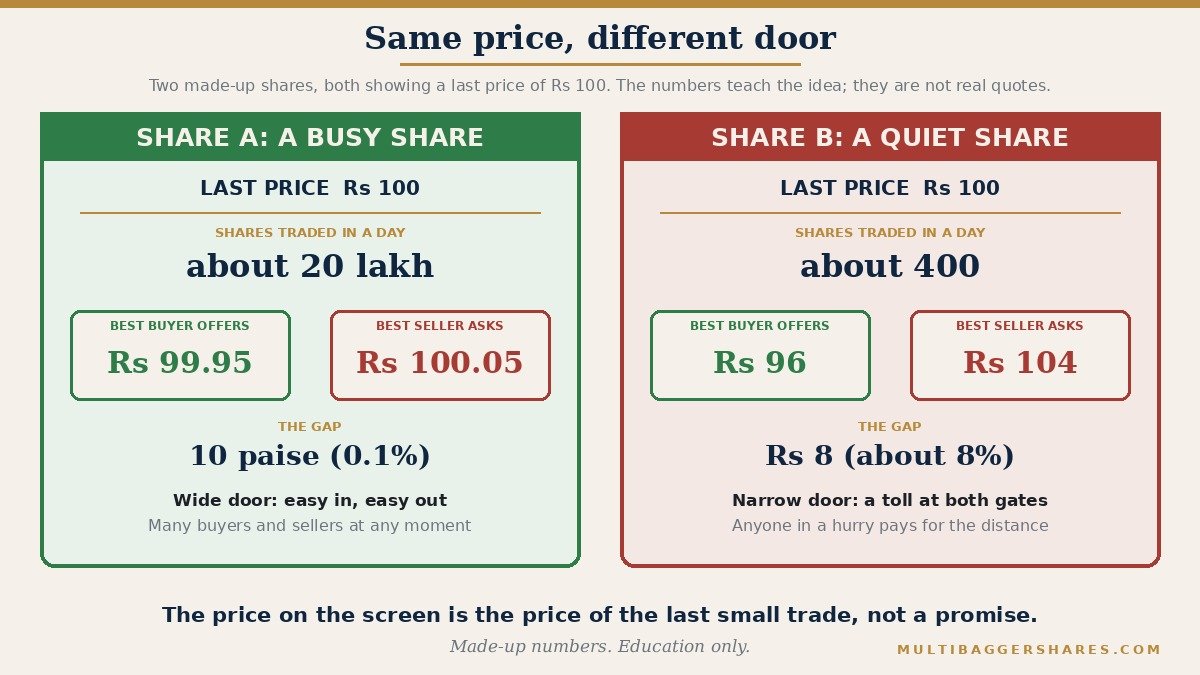
Kiran has Rs 5 lakh to put into shares, and he finds two he likes the look of. Everything about Kiran and these two shares is made up to teach an idea. Let us call them Share A and Share B. Both show a last traded price of Rs 100 on the screen. Both belong to sound, profitable businesses. If you looked only at the price, you would say they are the same.
But look at the doors. Share A is busy. About 20 lakh shares of it change hands every day, and at any moment there are many people waiting to buy and many waiting to sell. The best buyer is offering Rs 99.95 and the best seller is asking Rs 100.05. The gap is 10 paise. Share B is quiet. Only about 400 shares change hands in a whole day. The best buyer is offering Rs 96, and the best seller is asking Rs 104. The gap is Rs 8.
Kiran does not think about any of this on the day he buys. A year later, a hospital bill arrives and he needs cash from the quiet share, quickly. That is the day he learns that a price on a screen is an opinion about the last small trade. It is not a promise that you can turn your shares into cash at that price, today, in the amount you want. Today’s lesson is about that difference.
What it really means
Finance people use one word for this: liquidity (how quickly and how cheaply you can turn something into cash without pushing its price against yourself). A rupee note is perfectly liquid. A savings account is nearly so. A flat in the city takes weeks or months to sell. A share sits somewhere in between, and it sits at different points for different shares.
Think of selling a popular small car, the kind seen on every road. Within a day or two you can find a buyer, and you roughly know the price, because hundreds of the same car have sold this month. Now think of selling a rare vintage car. It may be worth a great deal on paper. But there are only a few people in the whole city who want one, and you must wait for the right one to turn up. If you cannot wait, you take less. A busy share is the popular small car. A quiet share is the vintage car.
There are a few simple words to know. Trading volume (how many shares change hands in a day) tells you how busy the door is. The bid (the highest price a buyer is offering right now) and the ask (the lowest price a seller will accept right now) tell you the going rates on each side. The gap between them is called the spread. A narrow spread means the market agrees on a price. A wide spread means buyers and sellers are far apart, and anyone in a hurry pays for the distance.
Two more words matter in India. Free float (the shares actually available for the public to trade, as opposed to those held firmly by promoters and other long-term holders) tells you how many shares are really moving. And a price band (a rule set by the exchange that stops a share’s price from moving more than a fixed percentage in a day) can, for some shares, be quite narrow. On a day when a quiet share has more sellers than buyers, the price can hit the lower band and stay there, with sellers queuing and no one to take their shares.
Why it works
Here is the part that surprises most beginners. Liquidity is something you do not notice on good days and cannot do without on bad ones. Most of the time it costs nothing, because you are not selling. It only shows up in the one moment you must sell, and by then it is too late to change the door.
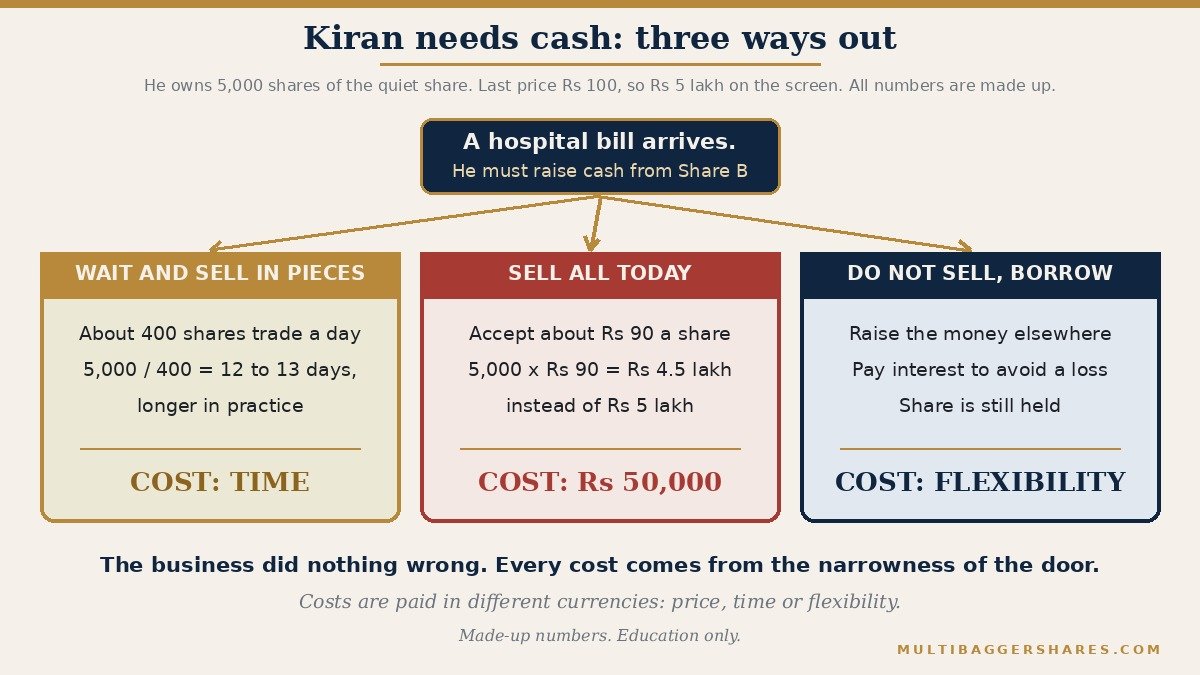
Go back to Kiran. He owns 5,000 shares of the quiet share, so the screen says Rs 5 lakh. If he tries to sell them all today, there are not enough buyers at Rs 96, or even at Rs 100. Suppose the only way to find enough buyers today is to accept about Rs 90 a share. He gets Rs 4.5 lakh. Rs 50,000 has vanished. The business did nothing wrong. Its profits did not change. The loss came entirely from the narrowness of the door.
He has other choices. He could sell in small pieces, a few hundred shares a day. At about 400 shares traded daily, even if he were the only seller, 5,000 shares would take roughly 12 to 13 trading days, and in practice he would be pushing the price down with every sale, so it would take longer. Or he could avoid selling and borrow instead, which means paying interest to avoid a loss. Every road costs something. The cost is simply paid in different currencies: price, time, or flexibility.
The same shares that are hard to sell are often hard to buy at a fair price, too. When Kiran first bought, he paid close to the ask of Rs 104, not Rs 100. So even before anything happened, he was Rs 4 per share, or about 4%, behind. A wide spread is a toll that is charged at both gates.
There is a deeper idea here, and a famous economist put it well. John Maynard Keynes, in his 1936 book The General Theory of Employment, Interest and Money, pointed out that one person’s liquidity is not the community’s liquidity. Each single investor can feel safe because he can sell. But all investors cannot sell together, because someone has to be on the other side. In his words, there is “no such thing as liquidity of investment for the community as a whole.” A cinema hall has wide exit doors for exactly this reason. Not because people plan to leave in a hurry, but because on the one day they all must, a narrow door is a danger.
A real example or two
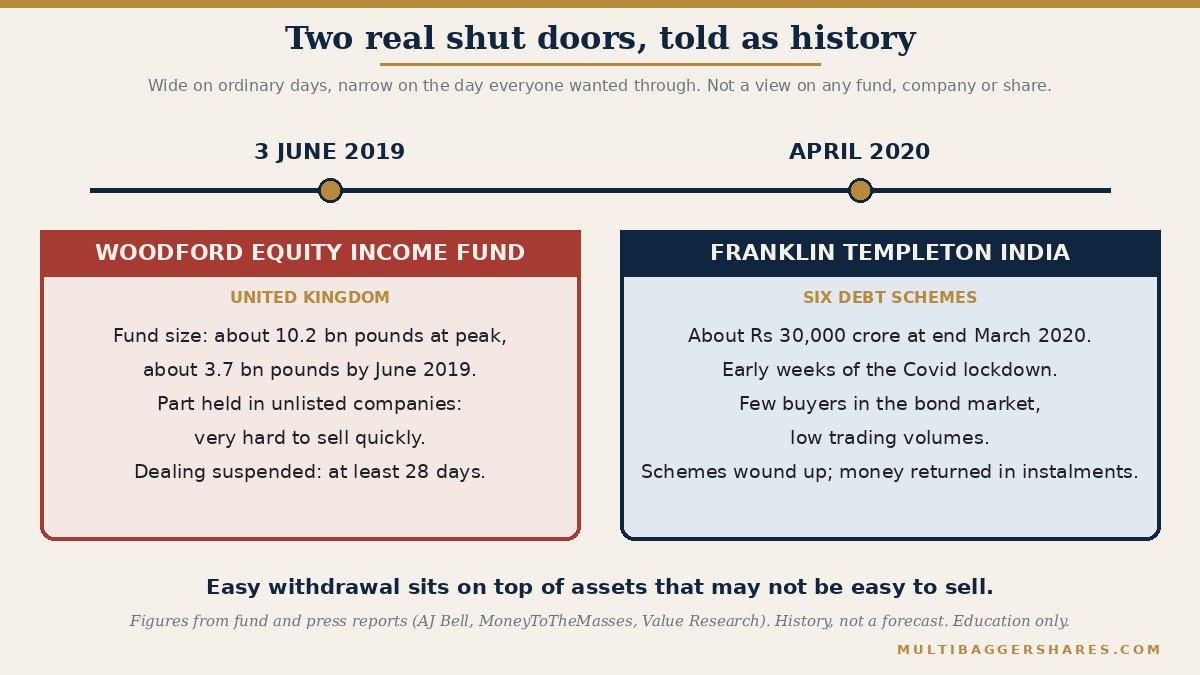
Our first example comes from the United Kingdom, and we tell it only as history. The Woodford Equity Income Fund was a large mutual fund (a pool of money from many ordinary investors, managed by one professional). At its peak it held about 10.2 billion pounds. Over time, many investors withdrew their money, and the fund shrank to about 3.7 billion pounds. Part of what it owned was shares in unlisted companies, which are businesses whose shares do not trade on an exchange at all and are therefore very hard to sell quickly.
On 3 June 2019, the fund stopped letting investors take their money out. This is called suspending dealing. It was set to last at least 28 days. People who had put their savings in believing they could withdraw whenever they liked now found the door shut. Later that year, the fund was set to be wound up. The lesson is not about the fund manager’s skill or any one share. It is that a promise of easy withdrawal sits on top of assets that may not be easy to sell. When the two do not match, the door shuts at the worst moment.
Our second example is from India. In April 2020, during the early weeks of the Covid lockdown, Franklin Templeton Mutual Fund wound up six of its debt schemes (funds that lend money by holding bonds, which are IOUs issued by companies). Those schemes held about Rs 30,000 crore at the end of March 2020. The reason given was a shortage of buyers in the bond market, with low trading volumes and rising yields, which meant the schemes could not raise enough cash to meet withdrawals. Investors received their money back in instalments over the following years, rather than all at once.
Notice what these two stories share. Neither is a story of a bad business falling to zero. Both are stories of a door that was wide on ordinary days and narrow on the day everyone wanted through. We tell them as history, not as a view on any fund, company or share.
In fairness, we should say the other side too. A narrow door is not a crime. Plenty of sound businesses have shares that trade lightly, and an investor who never needs to sell them may never feel the narrowness. Keynes himself worried that too much ease of exit tempts people to trade often and think short. The point is not that quiet shares are bad. The point is to know which door you are standing in, and to make sure your need for cash does not arrive before your ability to get it.
How you can use it
You do not need any special training to use this idea. It is a handful of simple questions you ask before you own something, not after. Everything below is a way of learning to think. It says nothing about any particular company, fund or share, and it is not a plan for any individual.
Question one: how many shares trade on a normal day, compared with how many you plan to own? If your holding is a small slice of one day’s trading, the door is wide. If it equals several days or weeks of trading, the door is narrow for you, whatever it is for others. Look at the volume over a few months, not a single busy day, because one burst of excitement can mislead.
Question two: how wide is the gap between the best buyer and the best seller? A gap of a few paise on a Rs 100 share is a sign of an agreed price. A gap of several rupees means that you pay a toll to enter and a toll to leave. Think of it as an extra cost that is easy to forget because it never appears on a bill.
Question three: how much of the company is actually free to trade? If promoters and other long-term holders own most of it, the free float is small, and a few sellers can move the price a lot. A small free float is not always a problem, but it is a reason to size your position with care.
Question four: has this share been hitting its price band? A share stuck at its lower band for days, with sellers queuing, is a live picture of a narrow door.
Question five: when will I need this money? Money you may need soon should not stand behind a narrow door. Money with a date far away can afford to sit behind one, as long as you keep enough steady money elsewhere that you never have to force the door. The shorter your date, the wider the door you want.
One more habit helps. Ask yourself, “If I had to leave this holding over a few weeks, without pushing the price against myself, could I?” If the honest answer is no, then the size of the holding is too big for the door, even if the business is a fine one. Many wise investors treat this as part of sizing, which means deciding how much of your money goes into any single thing.
There is calm in this habit. You cannot predict the day a bill arrives or the day the whole market wants to leave at once. But you can choose, ahead of time, to stand near wide doors with the money you may need, and to give narrow doors only the money that can wait. When the crowd rushes, you will not be in it. This article is for education only. It does not tell you what to do with any particular investment.
Key takeaways
- A price on the screen is the price of the last small trade, not a promise that you can sell your whole holding at that price today.
- Liquidity (how easily and cheaply a share can be turned into cash) shows up in volume, the gap between the best buyer and best seller, and the free float.
- A wide door costs nothing on good days and is priceless on bad ones; a narrow door costs you in price, time or flexibility the day you must sell.
- Told as history: the Woodford fund in June 2019 and six Franklin Templeton India debt schemes in April 2020 both found that easy withdrawal sits on top of assets that may not be easy to sell.
- Before you own something, ask how long it would take to leave without pushing the price, and keep money you may need soon behind wide doors only.
Educational content. This article is for education only. It is not a research report and not a recommendation to buy, sell or hold any security, and it does not take your personal circumstances into account. The securities quoted are for illustration only and are not recommendatory.
Investment in securities market are subject to market risks. Read all the related documents carefully before investing.
Registration granted by SEBI, enlistment as RA with Exchange and certification from NISM in no way guarantee performance of the intermediary or provide any assurance of returns to investors.

Manish GoelChartered Accountant and SEBI Registered Research Analyst (INH100004775). Writes about business quality, valuation and investor behaviour. About