Value investing · Educational
The Bigger Engine: Why, in the Early Years, How Much You Save Matters More Than How Well You Invest
Two friends, two engines, and a simple sum: for the first sixteen years or so, the amount you put in does more work than the return you earn.
Tanvi and Rohan start their first jobs in the same month. They are made up for this story, but you probably know two people just like them. Both decide to invest a fixed sum every month and leave it alone.
Tanvi is the sharp one. She reads, she compares, and she is confident she can earn 12% a year on her money. She can spare Rs 10,000 a month. Rohan is the steady one. He expects a more modest 8% a year, but he is willing to put away Rs 15,000 a month, which is half as much again.
Who is ahead after five years? Most people guess Tanvi, because 12% sounds so much better than 8%. In fact Tanvi has about Rs 8.2 lakh (a lakh is one hundred thousand), and Rohan has about Rs 11 lakh. After ten years it is Rs 23 lakh for Tanvi and about Rs 27 lakh for Rohan. The steady saver is ahead, and he stays ahead for about sixteen years.
Then something changes, and Tanvi starts to pull away. By year thirty she holds about Rs 3.5 crore (a crore is ten million) and Rohan about Rs 2.2 crore. The sums in this story are illustrations, and they are explained in a moment. The pattern inside them is the point, and it is worth understanding before you spend a single hour hunting for a better return.
What it really means
Every pot of invested money is built by two engines. The first engine is your savings, the money you add each month from your own pocket. The second engine is the return, the growth that the money you already hold earns by itself. A return is simply the extra money your money makes, shown as a percentage of the amount invested.
In the early years, the first engine does nearly all the work. Think of planting a young mango tree. In the first years it is tiny, so the rain that falls on it hardly matters, and what matters is the bucket of water you carry to it every day. Years later the tree is huge, and the rain falling on its branches and roots does far more than your bucket ever could.
Money behaves the same way, and the reason is plain arithmetic. A return is a percentage of what you already hold. When the pot is small, even a very good percentage of a small sum is a small sum. In the first year, Tanvi’s 12% on a pot that averages around Rs 60,000 is only about Rs 7,000. Her own savings add Rs 1.2 lakh over the same year. Her contribution outweighs her return many times over.
This idea has a famous companion called compounding (earning returns on your past returns, interest on interest, like a snowball rolling downhill). Compounding is real and powerful, but it needs something to compound. A snowball the size of a marble gains almost nothing from a roll down the hill. The same hill makes a boulder out of a snowball that is already large. So the first job is to make the snowball large enough for the hill to matter.
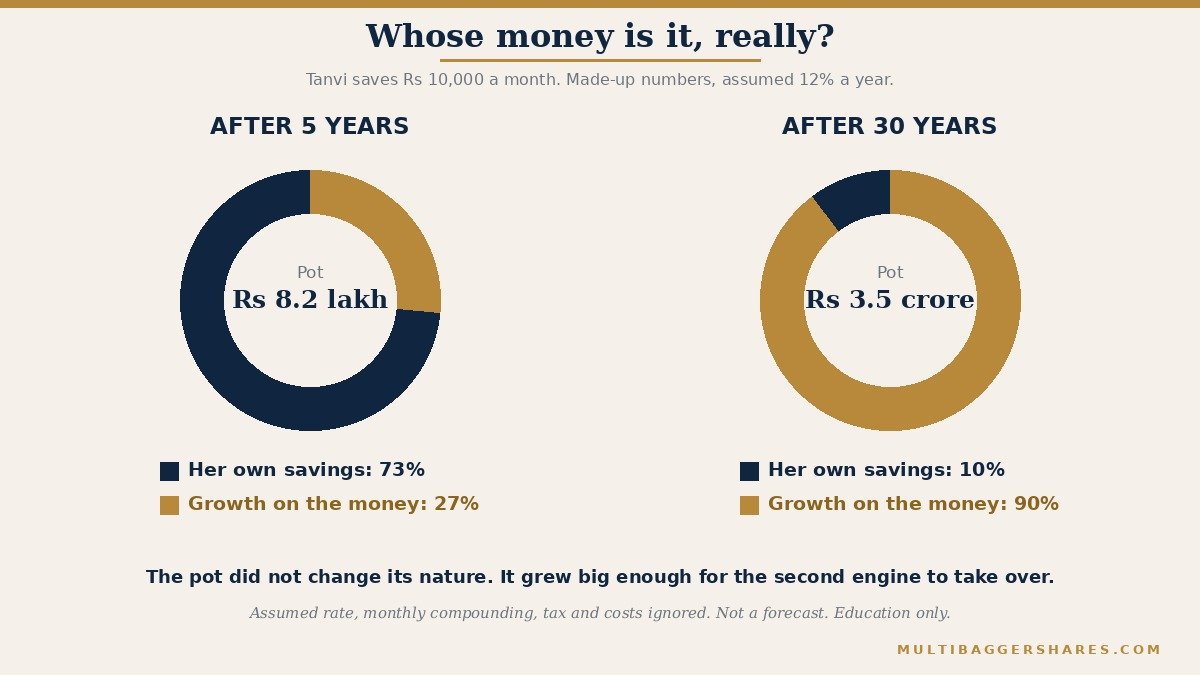
The picture above shows the same thing for Tanvi alone. After five years, about three-quarters of her pot is her own money and only about a quarter is growth. After thirty years the picture has flipped, and about nine-tenths of the pot is growth. The pot did not change its nature. It simply grew big enough for the second engine to take over.
Why it works
There are three reasons the savings engine leads early, and each one can be checked on the back of an envelope.
The first reason is size. As we saw, a return is a percentage of the pot, and the pot starts at zero. In month one, Tanvi’s 12% is worth nothing at all, because there is nothing yet to grow. Only her Rs 10,000 exists. The return has to wait for the savings to build a base for it to work on.
The second reason is control. You cannot set the return. Markets rise and fall on news that nobody can predict, and a rate of 12% a year is a hope and never a promise. You can set the amount you save. It is the one dial that is fully in your hands, and it works from the first month. A sensible person puts effort into the thing that responds to effort.
The third reason is reliability. The return you hope for may not arrive in the first five years, or ten, or even fifteen. Your savings arrive every month without fail. That steadiness matters for a very human reason: people who see a solid pot growing month by month find it easier to stay calm when markets turn rough. A saver who has been adding Rs 15,000 a month for years has a pot that holds up even through a dull stretch of returns.
A quick test makes this concrete. Suppose Tanvi, still at 12%, adds Rs 2,000 to her monthly saving. After ten years her pot is about Rs 27.6 lakh instead of Rs 23 lakh, a gain of about Rs 4.6 lakh. Now suppose that, with no extra saving, she somehow earned one percentage point more, 13% instead of 12%. After ten years she has about Rs 24.4 lakh, a gain of only Rs 1.4 lakh. The extra Rs 2,000 a month beat the extra percentage point more than three times over, and it was fully in her control. Even after twenty years the extra saving still leads, adding about Rs 19.8 lakh against about Rs 14.4 lakh for the extra point.
Now look at what happens when the pot gets big. The returns begin to do the heavy lifting, and the engines swap roles. In our story the crossing point comes at about sixteen years. After that, Tanvi’s higher rate wins, and it keeps winning by a wider margin each year. This is not a contradiction. It is the same arithmetic seen at a later date.
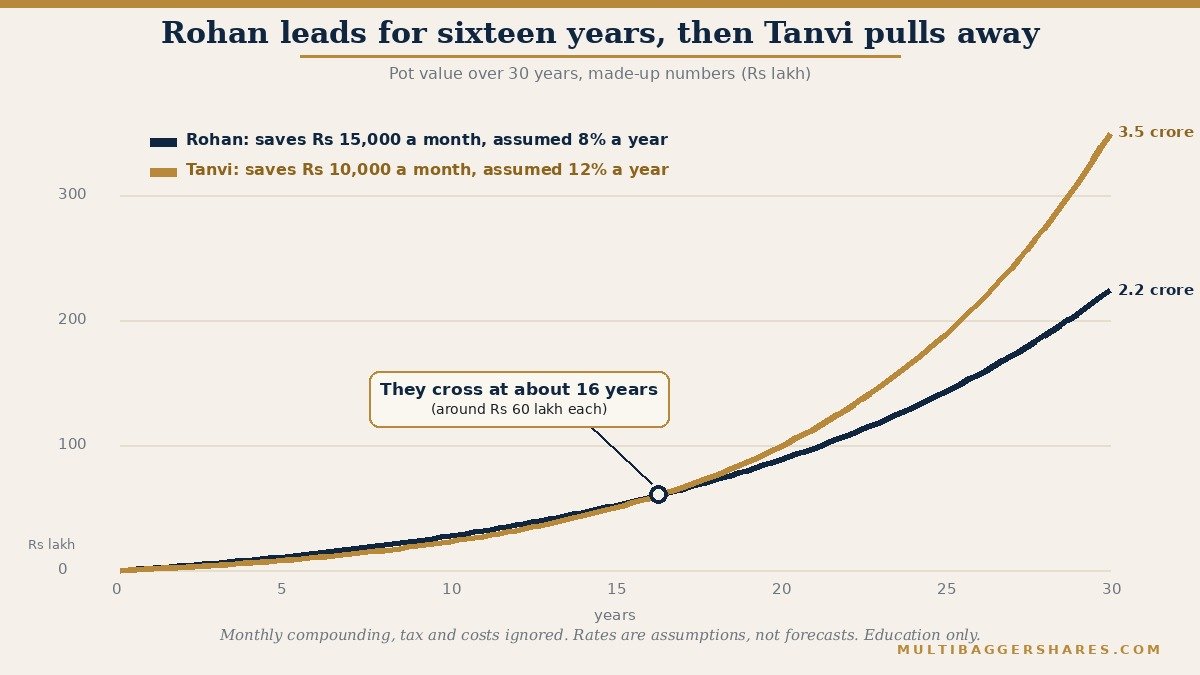
Please do not read the second half of the story as a message that a higher return is the whole game. Look at how much of the final gap comes from one assumption. Tanvi is assumed to earn 12% every single year for thirty years. Real markets do not behave so neatly, and a rate that high is far from guaranteed. If Tanvi had earned the same 8% as Rohan on her smaller sum, she would have only about Rs 1.5 crore after thirty years, well below his Rs 2.2 crore.
It is worth adding that chasing a higher return usually means accepting a bigger risk of loss, and that risk can wipe out years of patient saving in one bad stretch. The return you hope to earn is not a free choice, and it comes with a price. The extra rupees you save come with no such price.
A real example or two
Ronald Read lived in Brattleboro, a small town in the American state of Vermont. He worked for many years as a gas station attendant and later as a janitor (a person who cleans and looks after a building) at a department store. He was the first person in his family to finish high school. Those who knew him saw a quiet, careful man who drove a second-hand Toyota Yaris, held his coat together with safety pins and cut his own firewood.
When Read died in June 2014, at the age of 92, it came out that he had left an estate (everything a person owns at death) of about $8 million. Most of it, about $6 million, went to the town’s hospital and its library. The gifts of $4.8 million to the hospital and $1.2 million to the library were the largest either had ever received. Almost nobody around him had known.
How did a janitor build that? A friend told reporters that if Read earned $50 in a week, he probably invested $40 of it. That one sentence is the first engine at full power: a very high share of income went into investments, month after month, for decades. Read was also a patient owner of shares who held on for a long time, so he used the second engine too. But the first engine ran first, and without it the second would have had nothing to work on. This is told purely as history. It is not a claim about any share he owned, and it is not a suggestion to copy his portfolio.
India offers a quieter version of the same truth in many households. Think of the family that puts a fixed sum into an investment every month from the first salary, while a neighbour of equal pay spends the same sum on a bigger car and waits for the right moment to begin. Ten years on, the first family may be ahead even if the neighbour finally found a better return. Starting early and adding steadily is the part within anyone’s control.
How you can use it
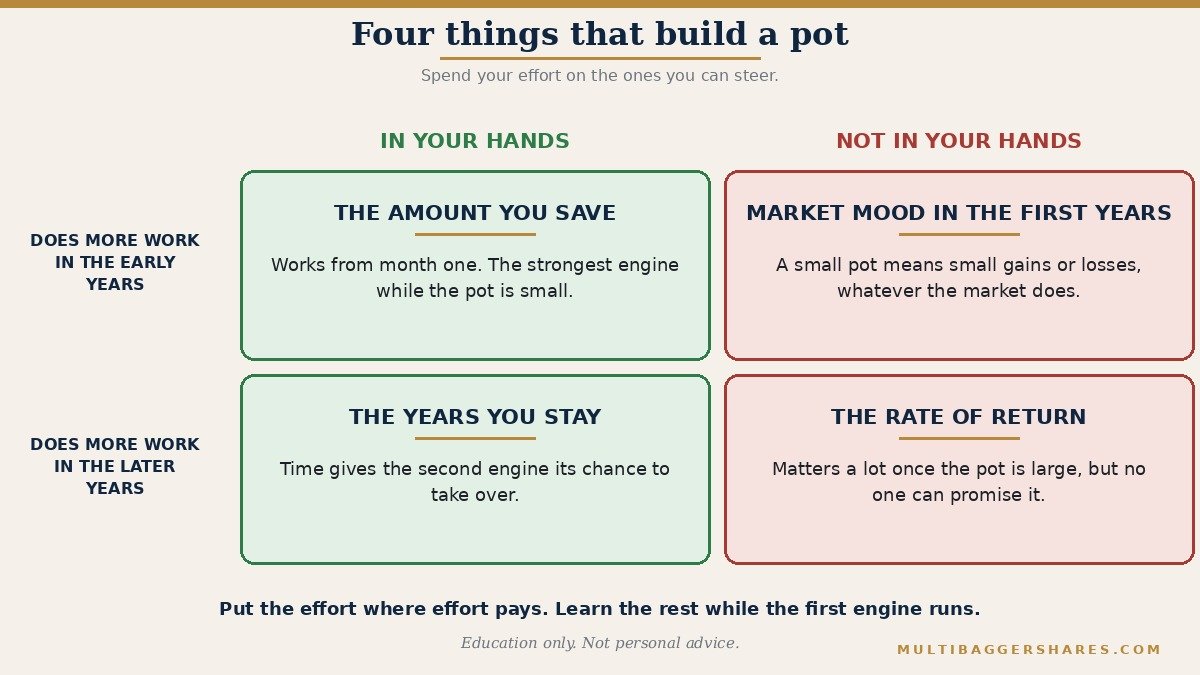
The picture above shows the four things that build a pot. Two are in your hands and two are not. The sensible idea is to spend your effort on the ones you can steer. Here is how a beginner can do that in plain steps.
First, decide the amount before you decide the product. Many beginners spend weeks choosing among investments and almost no time choosing how much to put in each month. In the early years, the amount decides the size of the pot far more than the choice does. Work out what you can put aside after your regular costs and an emergency cushion (a few months of expenses kept in an easily reachable place), and set that sum as a standing monthly instruction.
Second, raise the amount when your income rises. When your pay goes up by 10%, consider raising your monthly saving in step with it, and let the rest of the raise improve your daily life. This small habit grows the first engine without any extra sacrifice, because you never felt the money in your hands. Some people call it a step-up. It is simply a promise to your future self that a raise will be shared.
Third, begin now rather than after the “right time”. A rupee saved this year has the longest time to benefit from the second engine later. Waiting a year for a better moment costs you a year of the first engine, and nobody can tell you in advance which moment is better.
Fourth, keep costs low and keep it simple. Fees, taxes and a hasty change of plans take a small bite out of the return every year, and the bites add up over decades. Since you cannot control the market, control what you pay and how often you disturb your own plan.
Fifth, stay long enough for the second engine to arrive. The crossing point in our story came after sixteen years. Anyone who gives up at year ten, because the pot looks small next to a friend’s tale of a lucky investment, never reaches the stretch where the pot starts to grow on its own. Time is the quiet partner of both engines.
You may wonder whether this means the return does not matter. It does matter, and a lot, in the later years. The lesson is about order and effort. At the start, put your effort into the amount, because that is where effort pays. Learn about businesses, learn to tell good ones from weak ones, and learn to stay calm, because all of that will count when the pot is large. But do not delay the first engine while you wait to perfect the second.
This article is for education only. The people, amounts and rates in the story are made up, and a return of 12% or 8% is not a forecast or a promise. It does not tell anyone how much to save or what to do with any sum of money.
Key takeaways
- Every pot is built by two engines: the money you add, and the growth that money earns. In the early years the first engine does almost all the work.
- In the made-up story, Rohan saves Rs 15,000 a month at 8% and stays ahead of Tanvi, who saves Rs 10,000 at 12%, for about sixteen years.
- A return is a percentage of the pot, so a small pot gets a small return. After five years about three-quarters of Tanvi’s pot is her own money; after thirty, about nine-tenths is growth.
- You cannot set the return, but you can set the amount you save, and it works from the first month. Raise it when your income rises, and start now.
- Ronald Read, a gas station attendant and janitor, left an estate of about $8 million in 2014. A friend said he invested most of what he earned. This is told as history only.
Educational content. This article is for education only. It is not a research report and not a recommendation to buy, sell or hold any security, and it does not take your personal circumstances into account. The securities quoted are for illustration only and are not recommendatory.
Investment in securities market are subject to market risks. Read all the related documents carefully before investing.
Registration granted by SEBI, enlistment as RA with Exchange and certification from NISM in no way guarantee performance of the intermediary or provide any assurance of returns to investors.

Manish GoelChartered Accountant and SEBI Registered Research Analyst (INH100004775). Writes about business quality, valuation and investor behaviour. About