Behavioural finance · Educational
Regret Aversion Bias: Why Indian Investors Dread the Decision More Than the Loss
The Bias: What Regret Aversion Really Is
Regret aversion (also called regret aversion bias or regret theory) is the tendency to anticipate the painful feeling of having made a wrong decision and to bias one’s choices to minimize that anticipated regret — even when it leads to objectively worse expected outcomes. It is closely related to, but distinct from, loss aversion. Loss aversion concerns the asymmetric pain of losing money. Regret aversion concerns the asymmetric pain of having chosen the action that produced the loss.
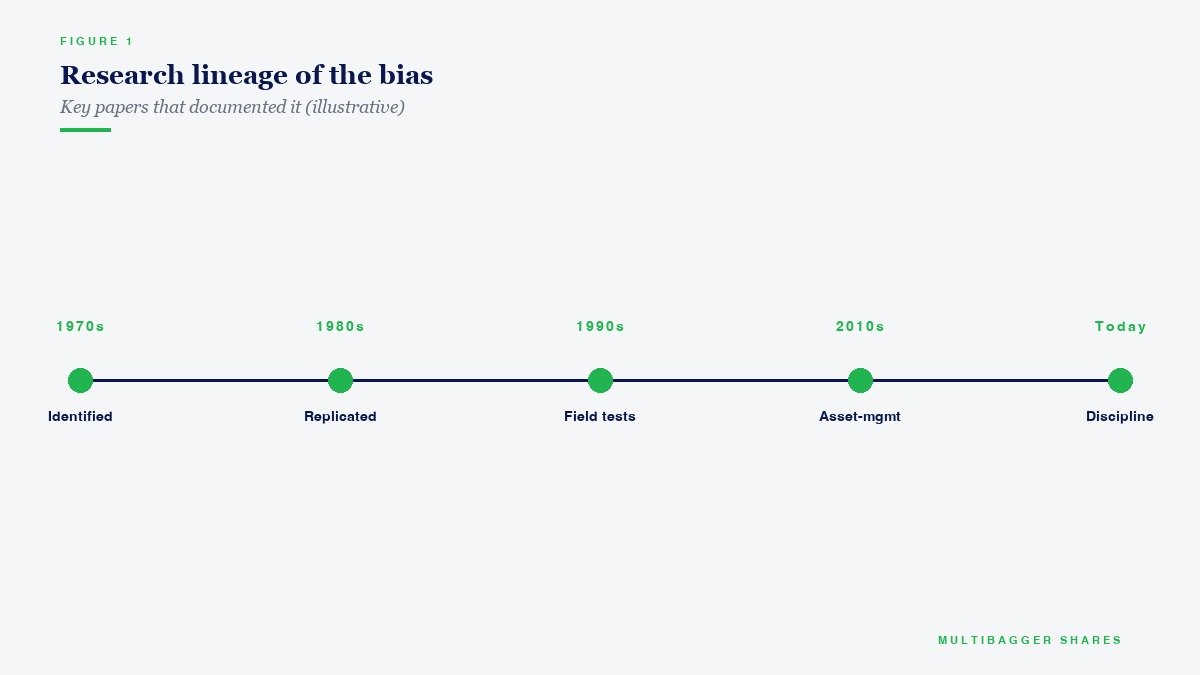
The formal academic foundation of regret theory was established in two landmark 1982 papers published in the same year: David Bell’s “Regret in Decision Making Under Uncertainty” (Operations Research, Vol. 30, No. 5, 1982) and Graham Loomes and Robert Sugden’s “Regret Theory: An Alternative Theory of Rational Choice Under Uncertainty” (The Economic Journal, Vol. 92, No. 368, 1982). Both papers showed that incorporating an anticipated-regret term into the utility function explains decision patterns that classical expected utility theory cannot — including the Allais paradox, status-quo bias and the disposition effect.
The intuition is simple. Suppose you are choosing between two options, A and B. Classical theory says you compute the expected utility of each and pick the higher one. Regret theory says you also implicitly compute “if I pick A and B turns out to have been the better choice, how much will it sting?” — and you weigh that anticipated sting into the decision. Because regret feels worse than an equivalent loss from an unchosen path (the so-called commission–omission asymmetry), the result is often inaction: refusing to choose at all.
The Underlying Psychology: Why Inaction Feels Safer Than Action
Daniel Kahneman and Amos Tversky’s earlier work on prospect theory (“Prospect Theory: An Analysis of Decision under Risk”, Econometrica, 1979) had already established that losses loom larger than gains by a factor of roughly 2.0–2.5×. Regret theory layers a second asymmetry on top: losses from action feel worse than losses from inaction. Kahneman and Tversky themselves studied this in 1982 (“The Psychology of Preferences”, Scientific American) using the now-classic stockbroker example — a man who switches from Stock A to Stock B and watches Stock A then go up feels much greater regret than a man who simply held Stock B and watched Stock A go up by the same amount.
Three psychological mechanisms reinforce regret aversion:
(1) Counterfactual thinking. The human mind reflexively constructs “what-if” simulations. The closer the counterfactual feels to reality (a near-miss), the sharper the regret. Indian investors who sold a quality compounder six months before a 60% rally remember it for years.
(2) Self-blame attribution. Regret carries a moral signal — “I should have known better.” Losses from inaction are blamed on circumstance (“the market was bad”); losses from action are blamed on the self.
(3) The status-quo default. Inaction never requires justification. Action does. So when uncertainty is high, the path of least psychological resistance is to do nothing — which compounds badly when the optimal financial decision was to act (start the SIP, rebalance, exit the loss).
The Indian Manifestation: Where Regret Aversion Shows Up in Retail Portfolios
Indian retail data — drawn from SEBI bulletins, NSE annual reports, and AMFI quarterly disclosures — shows regret-aversion fingerprints across several distinct patterns:
(a) The “Frozen FD” problem. Per RBI’s Handbook of Statistics on the Indian Economy 2024–25, Indian household financial savings remain disproportionately tilted toward bank deposits — over ₹190 lakh crore in scheduled commercial bank deposits as of FY25, against a free-float equity market cap of ~₹240 lakh crore. The behavioral driver is not absence of equity literacy; it is anticipated regret. A saver who shifts from FD to equity and watches a 25% drawdown experiences both the loss and the regret of having moved. The saver who stays in the FD experiences neither — even though the real (inflation-adjusted) FD return has averaged near zero over the last decade.
(b) The “post-rally entry” reflex. AMFI monthly equity inflow data shows a recurring pattern: SIP folios surge after 12-month market rallies (e.g., the ₹2.46 lakh crore equity-MF net inflow during FY24, which followed the Nifty’s 28% FY24 rally) and slow during corrections. This is regret aversion working in reverse — the regret of “having missed it” finally exceeds the regret of “buying near the top”. Investors enter at exactly the wrong moment. SEBI’s annual investor survey (2022) reported that 41% of new equity entrants between 2020–22 had begun investing within six months of the March 2020 lows being decisively breached on the upside.
(c) The “sell-into-strength too early” pattern. Prof. V. Ravi Anshuman (IIM Bangalore) and co-authors have documented in Indian-market behavioral-finance work that retail investors realize gains 2.4× faster than they realize losses on the same security — a sharper version of the Shefrin-Statman “disposition effect”. The driver is regret aversion of two flavours: realizing a profit closes the loop on the regret-of-future-reversal, while not realizing a loss avoids the regret-of-having-bought-at-all.
(d) The “won’t sell my Yes Bank” phenomenon. SEBI’s quarterly demat-account data shows that as of FY25, more than 4.2 crore unique demat accounts continue to hold defunct or near-defunct stocks (DHFL, Reliance Capital, Yes Bank pre-restructuring scrip etc.) at zero or fractional value. Selling forces the regret of crystallization. Holding preserves the fantasy that “it could come back”. This is regret aversion acting as a behavioral tax on portfolio hygiene.
(e) The “wait for the budget / wait for the result / wait for confirmation” loop. Indian investors disproportionately delay action around predictable calendar events — Union Budget, RBI policy, Q4 results, US Fed meetings. The objective expected-value impact of these events on a 10-year compounder is small. The regret-mitigation impact (being able to say “I waited to see what happened”) is large.
Counter-Measures: A Practical Anti-Regret Checklist
Regret aversion cannot be eliminated — it is hard-wired. But its damage to long-term compounding can be reduced by structural design. The following six-point checklist is drawn from behavioral-finance literature (especially Meir Statman’s Finance for Normal People, 2017, and Annie Duke’s Thinking in Bets, 2018) and translated to Indian retail conditions:
(1) Pre-commit through automation. SIPs, ECS mandates, NPS auto-debits, and quarterly rebalancing schedules remove the requirement for an in-the-moment decision. Anything pre-committed cannot be regretted in the moment of execution because the “decision” was made earlier, in a calmer state.
(2) Maintain a written investment policy statement (IPS). A one-page document specifying your asset-allocation bands, individual position-size limits, and the rules under which you sell. When the market moves, your IPS, not your gut, makes the call. Regret aversion is dramatically reduced when you can say “the IPS said sell” rather than “I sold”.
(3) Decision journaling. Before each material buy or sell, write down (a) the thesis, (b) the price, (c) the disconfirming evidence you would need to see, and (d) the time horizon. Twelve months later, re-read the entry. Over time the journal teaches you which of your impulses were process-correct and which were regret-driven.
(4) Pre-mortem the regret. Before each decision, explicitly ask: “If this turns out badly, what will I tell myself I should have done?” If the honest answer is “I should have stayed put”, you have evidence the decision is action-driven anxiety, not analysis. Conversely, if the answer is “I should have sized smaller”, that is a process input, not a regret signal.
(5) Separate the decision from the outcome. Annie Duke’s resulting framework — judge a decision by the quality of the process at the time it was made, not by what subsequently happened. Most regret is “resulting” in disguise.
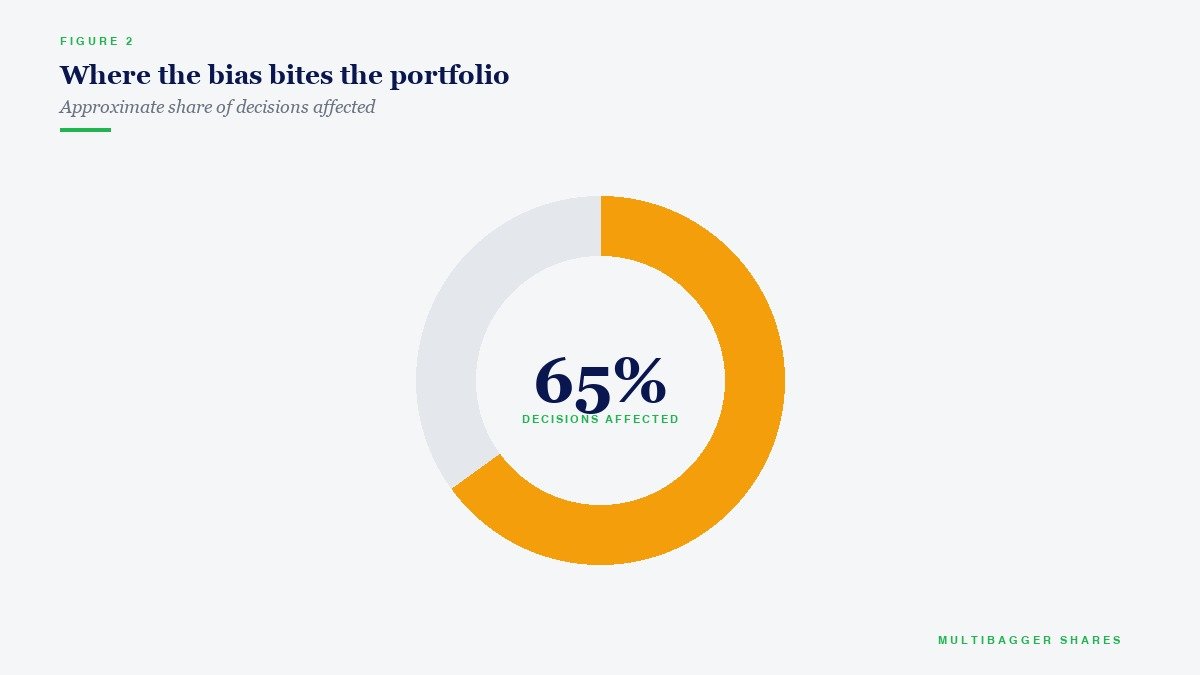
(6) Use the 10-year filter. Ask: “Will I remember this individual decision ten years from now?” For 95% of buy/sell impulses, the honest answer is no — at which point regret aversion loses its grip.
How the Greats Addressed Regret Aversion
Benjamin Graham built regret-resistance into The Intelligent Investor through the concept of margin of safety. By buying with a price-to-value cushion, Graham ensured that even adverse outcomes did not produce regret-inducing capital impairment. The 1949 edition explicitly warns against “anguished post-mortems”, recommending instead a written checklist applied identically to every situation.
Warren Buffett has repeatedly said in his annual-meeting Q&A that he “doesn’t look at quotes” between purchase and reassessment. This is not laziness — it is regret-aversion management. By not exposing himself to intermediate price action, Buffett removes 95% of the counterfactual triggers that drive regret. He has also said (1996 Letter): “The fact that the market sometimes acts irrationally doesn’t mean I should — and the fact that I sometimes act irrationally doesn’t mean I should keep doing so.“
Charlie Munger was the most explicit. His “lattice of mental models” approach treats regret as an information signal, not a feeling: regret about a process failure (poor research, wrong sizing) is useful and should drive change; regret about an outcome from a sound process is noise and should be ignored. Munger frequently used the phrase “iron-prescribed indifference to outcome volatility“.
Seth Klarman in Margin of Safety (1991) writes that the inability to act on conviction during market panics is “not a courage problem; it is a regret-engineering problem“. Klarman’s solution at Baupost is institutional: pre-approved buy lists with pre-approved sizing, ready to execute on price triggers, removing the in-the-moment regret-aversion friction.
Key Takeaways
To summarise the operational lessons of this article:
- Regret aversion is a 1982 academic concept (Bell; Loomes & Sugden) with hard real-world consequences for Indian retail wealth — most visibly in the ₹190+ lakh crore stuck in low-real-return FDs and the 4.2+ crore demat accounts holding defunct scrip.
- The cure is structural, not motivational. Automation (SIP, NPS, ECS), a written IPS, decision journaling, pre-mortems, the 10-year filter, and the resulting framework all work because they convert in-the-moment emotional decisions into pre-committed process.
- Inaction is itself a decision. The cost of “I’ll wait and see” compounds at the same rate as the cost of any other bad decision — but feels free because no commission was made.
- Buffett’s rule applies: “Never look at the quotes between purchase and reassessment.” Less observation = less counterfactual = less regret = better long-term returns.
Educational content. This article is for education only. It is not a research report and not a recommendation to buy, sell or hold any security, and it does not take your personal circumstances into account. The securities quoted are for illustration only and are not recommendatory.
Investment in securities market are subject to market risks. Read all the related documents carefully before investing.
Registration granted by SEBI, enlistment as RA with Exchange and certification from NISM in no way guarantee performance of the intermediary or provide any assurance of returns to investors.

Manish GoelChartered Accountant and SEBI Registered Research Analyst (INH100004775). Writes about business quality, valuation and investor behaviour. About